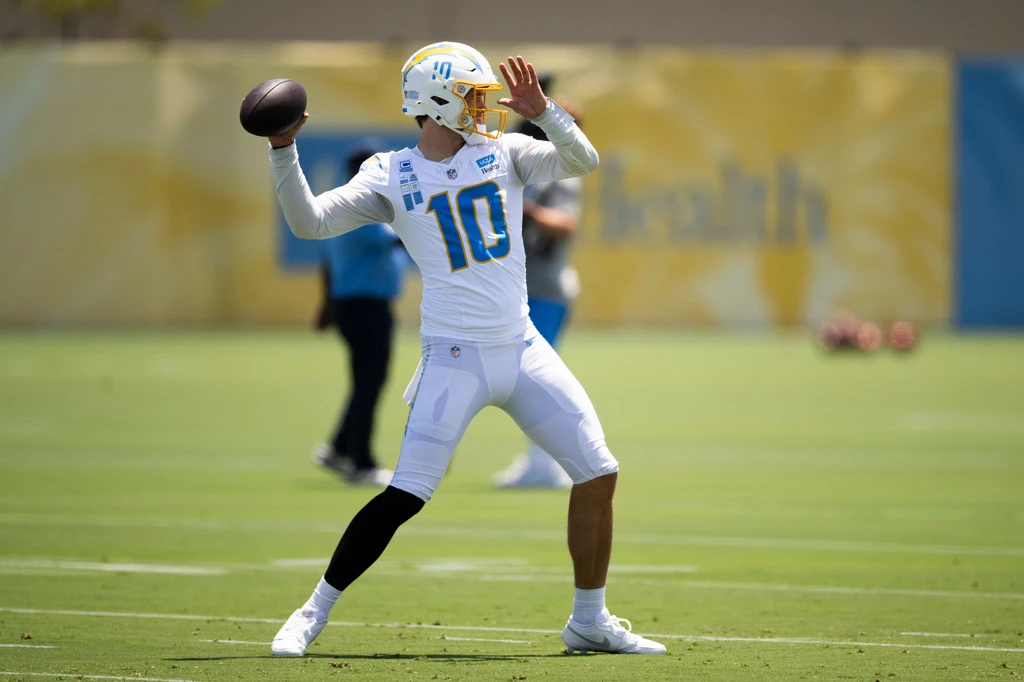
Justin Herbert is overhauling his footwork. Under new Chargers offensive coordinator Mike McDaniel, Herbert has adopted a modified shotgun stance — a technical adjustment McDaniel told ESPN on July 2, 2026 delivers a “millisecond competitive advantage” for executing run-pass option plays and completing passes quickly to receivers in space. At his June 2 OTA media session, Herbert confirmed he spent the offseason zeroing in on footwork and mechanics, adding that the new offense is built around getting the ball out fast and sharpening his timing and ball placement.
‘Unlocking the Next Level’: Chargers’ Offensive Overhaul
McDaniel, as ESPN reported on July 2, described the change as repositioning Herbert’s left foot slightly ahead of his right in his shotgun alignment — a shift in weight distribution that allows Herbert to initiate his throwing motion a fraction of a second sooner. The Athletic noted on October 5, 2026 that altering Herbert’s footwork was among the first things McDaniel did after taking over as offensive coordinator.
McDaniel arrives in Los Angeles after four seasons as head coach of the Miami Dolphins and, before that, as the 49ers’ offensive coordinator in 2021 following three years as San Francisco’s run game coordinator. Per Chargers.com, those four seasons in San Francisco produced the sixth-most rushing yards in the league (8,538), tied for seventh in explosive rushes of 10-plus yards (237), and ninth in rushing touchdowns (71). ESPN draft analyst Jordan Reid told Chargers.com that McDaniel’s scheme is built around “a lot of motions, shifts, keep defenses at bay and keep their mind wondering and swimming.”
The mechanical change itself is subtle but purposeful. Herbert’s adjusted base shifts his weight forward, enabling him to begin his delivery sooner — a gain that matters in a league where every fraction of a second between snap and release affects a quarterback’s exposure to pressure.
According to ESPN’s July 2 report, the stance is specifically designed to speed up RPO execution and get the ball to receivers in space before coverage can close. Herbert’s own June 2 comments reinforced that goal: the offense, he said, is centered on quick releases, better timing, and improved ball placement — all of which the footwork change is built to support.
The Postseason Puzzle: Can Herbert’s New Stance Deliver?
The baseline Herbert is building from is established. Per Chargers.com’s February 11, 2026 draft preview, he finished his sixth NFL season completing 340 of 512 passes (66.4 percent) for 3,727 yards with 26 touchdowns and 13 interceptions. McDaniel’s scheme — with its emphasis on early-down quick throws — is designed to build on that foundation rather than simply replicate it.
The stakes are real and the context is current. Herbert’s 2025 season was, as Chargers.com put it on February 11, “the driving force to get the Bolts to the postseason for a second consecutive year,” earning him his second career Pro Bowl selection. At his June 2 media session, Herbert acknowledged lessons learned from last year’s playoff loss. Chargers.com’s January 26 hire story noted that head coach Jim Harbaugh wanted “a new direction” on offense after back-to-back 11-win seasons that ended in early postseason exits — a pattern McDaniel was brought in specifically to break.
The stance tweak is one piece of a broader offensive overhaul. McDaniel’s system, as Jordan Reid described to Chargers.com, leans on motion and shifts to keep defenses off-balance, and ESPN’s July 2 report ties Herbert’s new footwork directly to executing those concepts — particularly RPOs and quick completions to receivers in space. It is not a cosmetic adjustment; it is structural.
The practical goal is to get the ball out before coverage rotates and defenders can close. Herbert said at his June 2 session that the offense’s emphasis on quick releases is central to everything McDaniel is installing — and Chargers.com has noted that McDaniel’s offensive vision is designed to both “elevate and protect Herbert.” The footwork change serves both aims simultaneously.
Whether the adjustment holds under live-game pressure is no longer hypothetical. The Athletic reported on October 5, 2026 that after McDaniel altered Herbert’s footwork ahead of his seventh season, the Chargers opened the year 0-4 — a result that has put the transition under immediate scrutiny. Herbert was described as receptive to the change, but the early-season record underscores that mechanical gains made in OTAs don’t automatically translate once a four-man rush arrives.
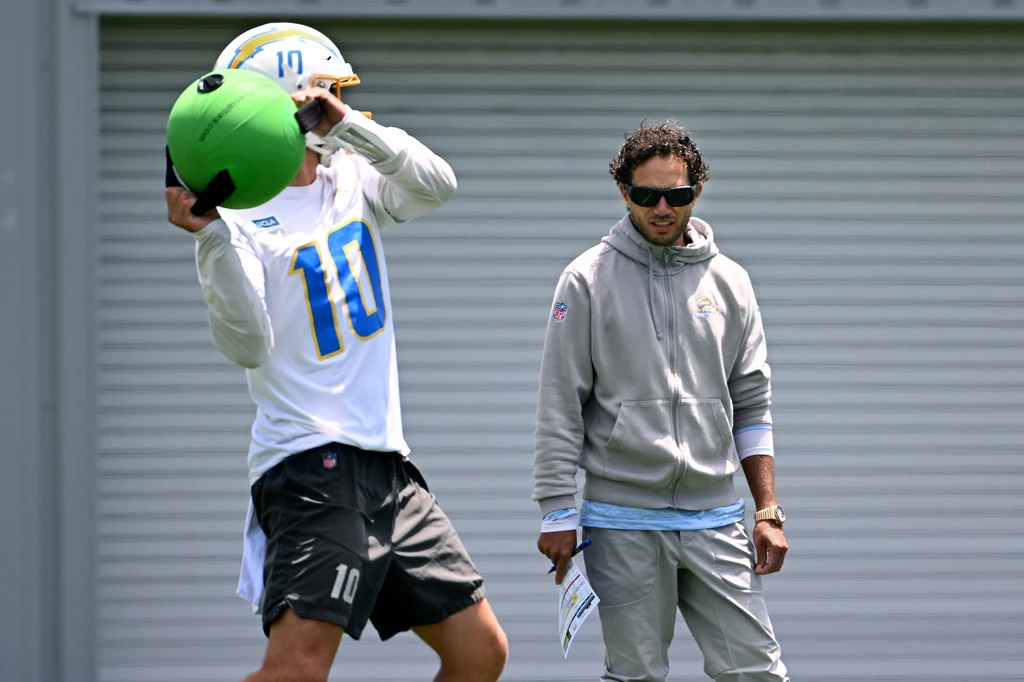
Mastering McDaniel’s System: Herbert’s Offseason Evolution
Protecting Herbert is a stated priority of the new scheme. Chargers.com has reported that McDaniel’s offensive vision is explicitly designed to “elevate and protect Herbert,” and Herbert himself noted at his June 2 session that having Joe Alt and Rashawn Slater back on the field is a significant factor in the offense’s outlook. A faster release cadence — enabled in part by the stance change — reduces how often Herbert holds the ball long enough to absorb a hit.
Herbert’s transition into McDaniel’s system has been hands-on from the start. At his June 2 OTA session, he described spending the offseason focused on footwork and mechanics, working to sharpen his timing and ball placement, and learning the offense alongside fullback Alec Ingold. The Athletic added that Herbert was “receptive” when McDaniel introduced the footwork change ahead of the season.
The learning curve is genuine. McDaniel’s system demands precise timing between quarterback and receiver, an ability to read how pre-snap motion shifts defensive responsibilities, and the processing speed to determine play structure before the snap. Herbert’s June 2 comments — centered on footwork, mechanics, and quick-release execution — reflect exactly the kind of groundwork that system requires.
The reception inside the building has been clear. Herbert told KCRA on August 7, 2026: “He loves football, he loves being here, and he loves his team. So it’s really cool to be a part of. And, you know, it makes everyone want to work harder for him.” Cornerback Nikko Reed added that McDaniel “has a lot of stuff cooking up,” while Derwin James described the offensive approach as “playing mind games” on defenses.
The early-season results, however, have complicated the picture. Chargers.com reported during training camp that Herbert was “progressing as fast as one could even picture” in the new offense. But The Athletic’s October 5 report — noting the Chargers’ 0-4 start — shows the transition is still very much unresolved once the games count.
Herbert and McDaniel: What the Pairing Still Has to Prove
Herbert’s mobility adds another dimension to what McDaniel can deploy. Per Chargers.com’s February 11 draft preview, he posted a career-best 498 rushing yards and two scores on the ground in his sixth season. ESPN’s July 2 report ties the stance change directly to RPO execution — a concept that becomes more dangerous when a defense has to account for Herbert as a genuine run threat.
The organizational stakes behind the McDaniel hire are specific. Chargers.com reported on January 26, 2026 that Harbaugh wanted “a new direction” on offense after consecutive 11-win seasons that ended in early playoff exits. Jordan Reid told Chargers.com the Herbert-McDaniel pairing “is going to work really well” given McDaniel’s motion-and-shift-heavy scheme — but that assessment is now being tested against a 0-4 start.
Herbert’s willingness to overhaul his mechanics at McDaniel’s direction is documented. The Athletic reported that one of the first things McDaniel did upon taking over was alter Herbert’s footwork, and that Herbert was “receptive.” Chargers.com has framed the footwork focus as an effort to get Herbert to “the next level of his career” in 2026.
The optimism heading into the season was grounded in specifics: a coordinator with a strong track record building run-game-heavy offenses in San Francisco and a scheme that fits Herbert’s physical profile, paired with a quarterback who finished 2025 with 3,727 passing yards, 26 touchdowns, and a career-best 498 rushing yards. Whether that combination can produce wins in January remains the only question that matters — and right now, with the Chargers sitting at 0-4, the answer is still being written.