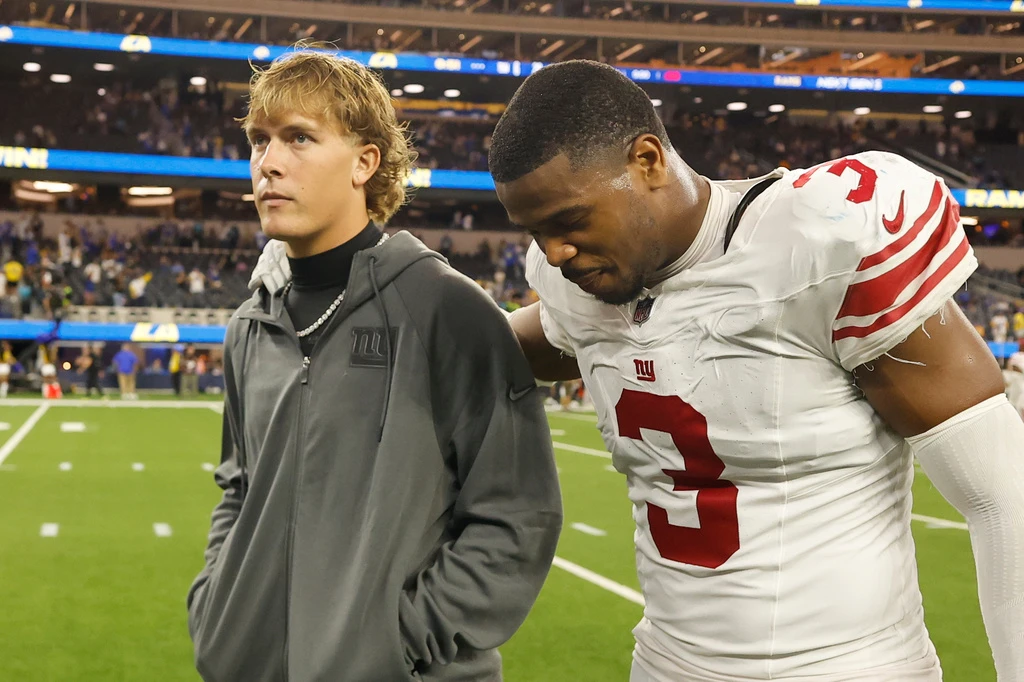
The New York Giants quarterback situation has taken a dramatic turn following Monday night’s matchup against the Los Angeles Rams.
What began as a promising sophomore campaign for Jaxson Dart has abruptly shifted into a lengthy rehabilitation process, leaving the franchise scrambling to adjust their plans for the remainder of the season.
The young quarterback who dazzled fans with his dual-threat capabilities and opened the season with a stellar performance now faces months on the sideline.
His injury has sparked conversations about playing style, recovery timelines, and what comes next for a team that invested significant draft capital to secure his services.
The Hit That Changed Everything: What Really Happened to Jaxson Dart?
The sequence unfolded rapidly during the Giants’ seventh offensive snap against the Rams. Linebacker Byron Young delivered a hit to Dart’s right side, forcing the quarterback into teammate Josaiah Stewart, who made contact with Dart’s legs from below. The collision sent Dart crashing to the turf in an awkward position that immediately raised concerns among those watching.
Dart’s reaction was instantaneous and telling. He clutched his left knee as soon as he hit the ground, a gesture that medical professionals and experienced observers recognize as a sign of significant trauma.
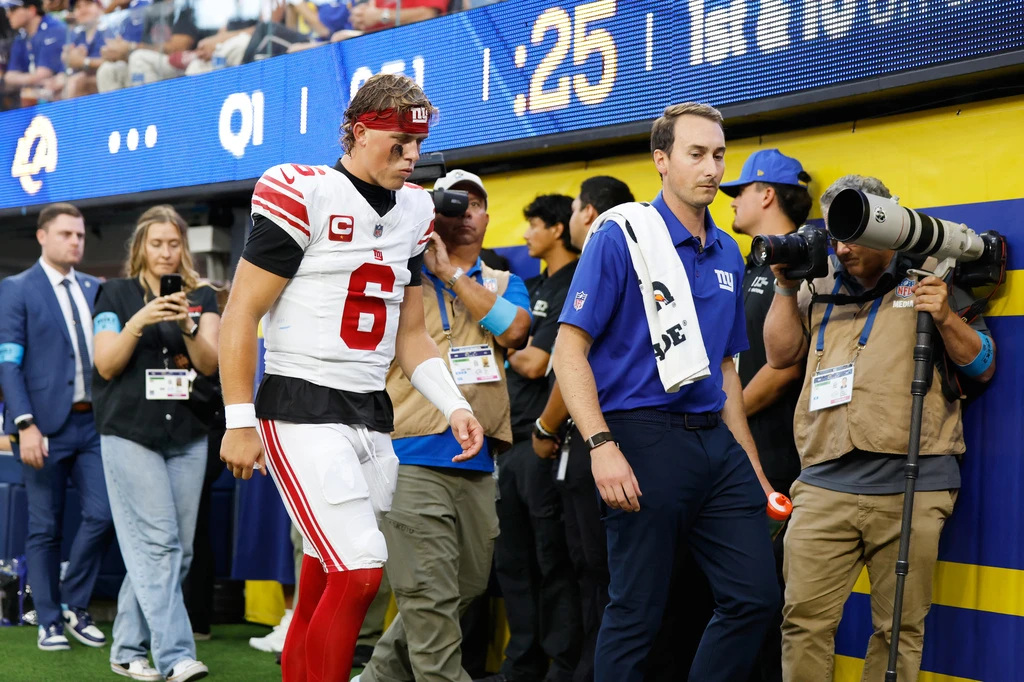
The quarterback made his way to the medical tent on the sideline, his gait noticeably compromised by a pronounced limp that suggested the injury was more than a minor tweak.
The Giants officially ruled him out early in the third quarter, though Dart had already departed for the locker room by that point. The timing of the injury was particularly cruel given how well the season had started, with Dart coming off a performance against Dallas that showcased everything the Giants hoped he would become.
His playing style, often compared to that of a linebacker operating at the quarterback position, had served him well throughout his rookie campaign but may have contributed to this unfortunate outcome.
Why the Initial Diagnosis Was Wrong (And What Doctors Found Instead)
Head coach John Harbaugh expressed cautious optimism immediately following Monday’s game, suggesting the team had probably avoided what he termed a disastrous outcome.
That initial assessment, based on preliminary examinations conducted in the immediate aftermath of the injury, painted a picture that would soon prove incomplete once more sophisticated imaging technology revealed the full extent of the damage.
Tuesday brought sobering news when detailed scans showed injuries to multiple structures within Dart’s left knee. The meniscus, MCL, and PCL all sustained damage requiring surgical intervention, a combination that transforms what might have been a manageable setback into a season-ending situation.
The one piece of positive news amid the concerning findings was that Dart’s ACL remained intact, sparing him from an even longer recovery period that would have extended well into the following season.
The Giants exhausted every available option before committing to surgery, seeking additional medical opinions and exploring whether any alternative treatment paths might preserve Dart’s availability for the current campaign.
This wasn’t the first time this season that Dart’s durability had become a concern for the organization, though previous incidents had been related to head injuries rather than his lower body.
Ultimately, the consensus among medical professionals left no viable alternative to surgical repair.
The Six-Month Question Everyone’s Asking—But the Answer Isn’t What You Think
Medical sources familiar with the type of damage Dart sustained indicate a recovery timeline of approximately six months from the date of surgery.
That projection places his potential return somewhere in the early spring, theoretically allowing him to participate in offseason activities and be fully prepared for the start of the 2027 season. The Giants have publicly expressed confidence that Dart will make a complete recovery and resume his role as the franchise quarterback.
However, Harbaugh notably declined to completely rule out the possibility of Dart returning should the Giants advance deep into the playoffs. The postseason begins in slightly less than four months, a timeframe that falls short of the projected six-month recovery period but leaves a narrow window of possibility if rehabilitation progresses exceptionally well.
Such optimism appears more aspirational than realistic given the nature of the injuries involved and the risks associated with rushing back from significant knee trauma.
The situation could have been considerably worse had Dart torn his ACL, an injury that typically requires at least nine months of recovery before athletes can return to competition. That distinction offers some consolation to a franchise and fanbase grappling with the loss of their starting quarterback for the foreseeable future. The focus now shifts entirely to ensuring Dart’s long-term health rather than chasing unlikely scenarios that might compromise his future effectiveness.
Jameis Winston’s Impossible Position: Opportunity or Curse?
Veteran quarterback Jameis Winston now inherits the starting role beginning with Sunday’s matchup against the Tennessee Titans.
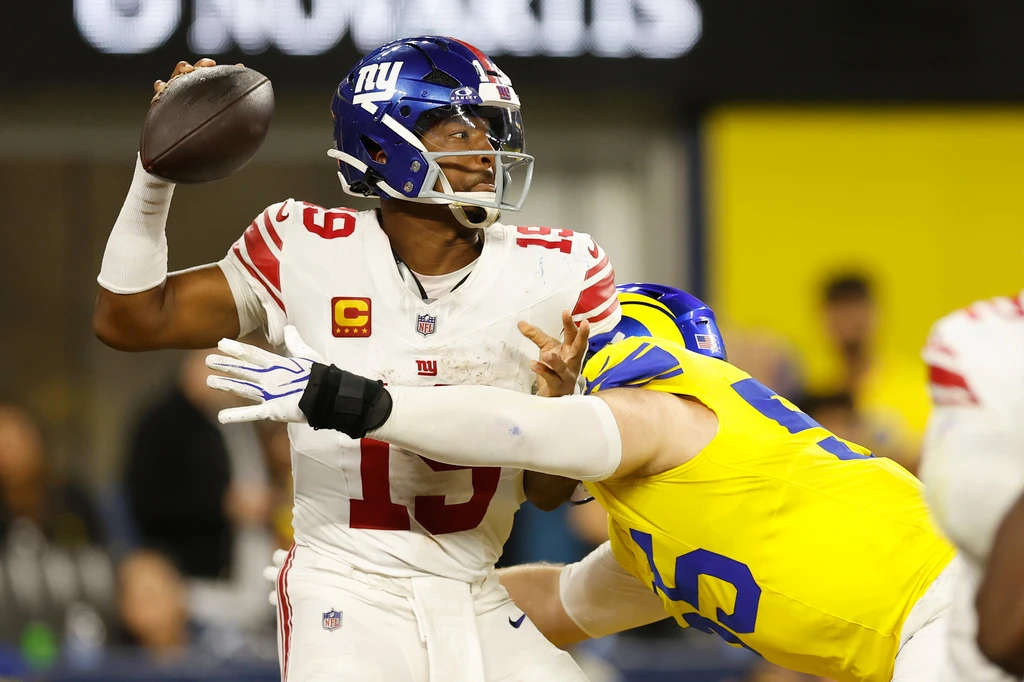
His performance after replacing Dart against the Rams did little to inspire confidence, as he completed just 11 of 27 pass attempts for 111 yards while throwing an interception in a lopsided defeat. Nevertheless, Harbaugh officially named Winston the starter and expressed faith in his ability to lead the offense moving forward.
Winston finds himself navigating complex emotional terrain as he prepares to assume greater responsibility.
The fans want to see wins. It’s not about what I’m showing them. It’s about us going out there and winning football games together, giving them something to cheer for, giving them something to stand behind. But right now, my heart, this is fresh. The opportunity is beautiful. It’s amazing. I’m grateful for it, but at the same time, I’ve got a brother that I’ve got to keep lifted up, and I have to prepare for a football game. But I’ve prepared for many football games, and I’ve dealt with injury before. I’ve had an injury that was really bad. So, balancing the two, but keeping a perspective of do what you can with what you have right now, where you’re at. “Jameis Winston (veteran quarterback)“, recognizing that his opportunity comes at the expense of a teammate’s misfortune. The veteran has maintained communication with Dart since the injury, offering support during what Winston described as a fresh and difficult period for the young quarterback.
The Giants are actively exploring options to bolster their quarterback depth beyond Winston and practice squad member Jake Haener, who is slated to serve as the backup against Tennessee. Harbaugh indicated the team will consider all available avenues, including free agent signings, practice squad acquisitions from other organizations, and potential trades.
The preference is to add a veteran presence who can provide insurance should Winston struggle or sustain an injury of his own during what promises to be a challenging stretch for the franchise.
What the Giants Aren’t Telling You About Dart’s Return Timeline
Dart was present at the team facility on Wednesday, attending meetings and spending time in the locker room despite his impending surgery.
Harbaugh characterized the quarterback as determined but understandably disappointed, noting that athletes typically experience a mourning process when confronted with significant injuries that derail their seasons. The exact date for the surgical procedure has not been disclosed, though sources indicate it will occur relatively soon.
The Giants selected Dart with the 25th overall pick in the 2025 draft after trading up from the early second round, a significant investment that reflected their belief in his potential as a franchise cornerstone.
His rookie season featured nine rushing touchdowns, the second-most among quarterbacks, and five games where he both threw and ran for scores. That dual-threat capability made him an exciting prospect but also exposed him to additional contact that more traditional pocket passers typically avoid.
Analysts have noted Dart’s tendency to absorb tackles rather than slide or step out of bounds when running with the football, a high-contact approach that generates extra yardage but increases injury risk. His aggressive playing style has drawn comparisons to a linebacker operating at the quarterback position, a characterization that captures both his physical toughness and the potential consequences of that mentality.
The Giants now face questions about whether they need to modify Dart’s approach when he returns, balancing the dynamic playmaking ability that makes him special against the durability concerns that have now cost him most of his second professional season.
The franchise currently stands at 1-1 and must navigate the remainder of the campaign without the player they envisioned leading them for years to come.