The 2026 college football season took a dramatic turn during Week 7, as five of the nation’s top seven teams suffered defeats on the same Saturday, completely transforming the College Football Playoff picture.
For the first time in AP poll history, five teams ranked inside the top seven lost on the same regular-season Saturday. Top-ranked Georgia fell to Auburn, No. 2 Notre Dame lost to BYU, and No. 5 Indiana saw its remarkable winning streak end against Ohio State. Alabama and Texas also suffered costly defeats, adding to a weekend of unprecedented chaos.
Meanwhile, third-ranked Miami narrowly escaped the upset wave with a dramatic 43-35 double-overtime victory over Florida State, preserving its undefeated record and emerging as the new No. 1 team in the Associated Press Top 25 rankings.
With the expanded 12-team College Football Playoff creating more opportunities for contenders, the results have dramatically changed the postseason outlook. Teams once considered championship favorites now face renewed pressure, while several rising programs have strengthened their cases for a place among college football’s elite.
Five Top-Seven Teams Fall in a Historic Weekend of College Football
Week 7 delivered one of the most unpredictable weekends in recent college football history, with several major upsets reshaping both the national rankings and conference championship races.
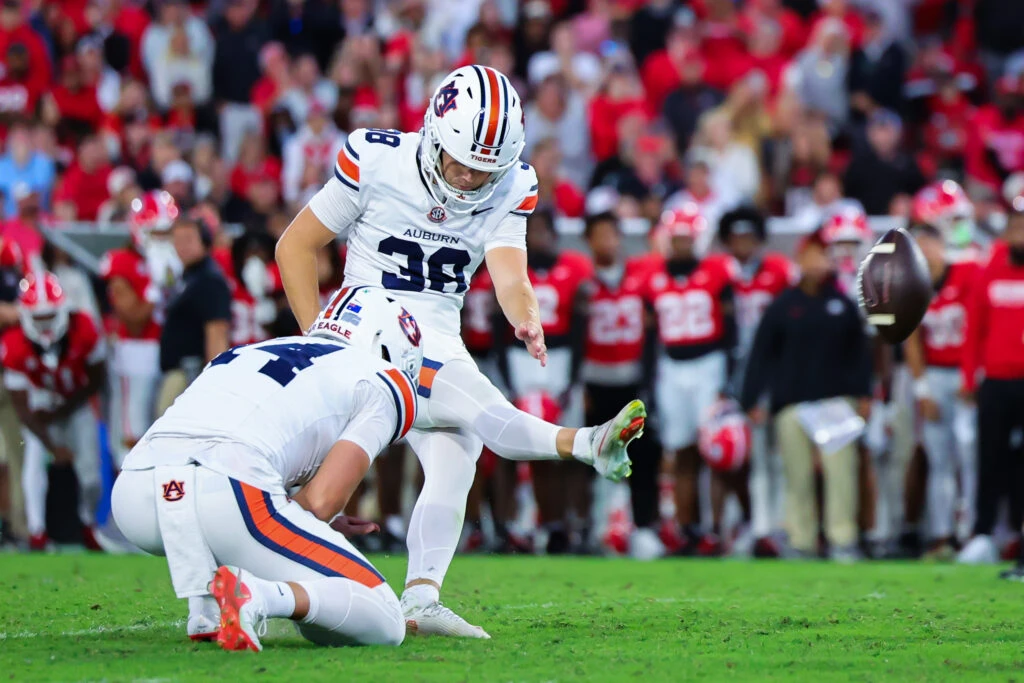
The biggest shock came in Athens, where top-ranked Georgia suffered a 27-24 defeat against Auburn.
The Bulldogs appeared to be in control after jumping out to an early 14-0 lead, but Auburn responded with 24 consecutive points to seize the advantage. Georgia eventually fought back to tie the game late in the fourth quarter, setting up a dramatic finish.
Auburn kicker Alex McPherson ultimately became the hero, connecting on a 34-yard field goal as time expired to secure the Tigers’ stunning victory.
The defeat marked Georgia’s first loss of the season and ended its nine-game winning streak against Auburn. It also demonstrated just how quickly championship expectations can change, even for the nation’s highest-ranked program.
According to the University of Georgia’s official game recap, the Bulldogs committed three turnovers, including a costly late fumble that gave Auburn the opportunity to win the game.
Elsewhere, Notre Dame experienced a similarly disappointing result against BYU.
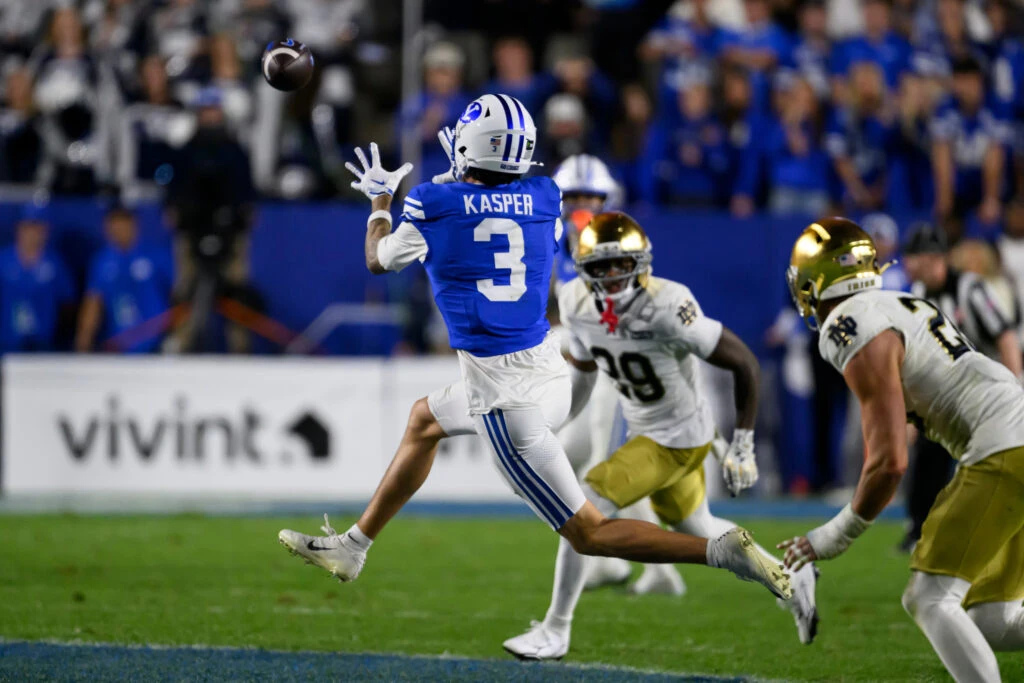
The eighth-ranked Cougars defeated the second-ranked Fighting Irish 28-24 in Provo, delivering one of the biggest victories in program history.
BYU quarterback Bear Bachmeier produced an exceptional individual performance, recording passing, rushing, and receiving touchdowns in the same game. His versatility proved decisive as the Cougars overcame one of the country’s strongest teams.
The victory propelled undefeated BYU to No. 2 in the national rankings, its highest position since winning the national championship in 1984.
Indiana also suffered a significant setback, falling 19-15 to Ohio State in a closely contested Big Ten matchup.
The Buckeyes ended Indiana’s 22-game winning streak, with wide receiver Jeremiah Smith contributing a critical 38-yard touchdown reception.
According to Ohio State’s official recap, the victory also snapped Indiana’s 19-game home winning streak and strengthened the Buckeyes’ position in the conference championship race.
The SEC experienced further turbulence as Tennessee defeated Alabama 26-10, while Florida stunned Texas 27-24.
Tennessee running back DeSean Bishop scored two second-half rushing touchdowns against Alabama, while Florida quarterback Tramell Jones Jr. helped engineer a comeback against the Longhorns in Austin.
Together, these results created an extraordinary weekend in which nearly every major championship contender faced unexpected pressure.
Miami Survives Florida State and Emerges as the New No. 1
While other highly ranked programs stumbled, Miami demonstrated its resilience in one of the weekend’s most entertaining games.
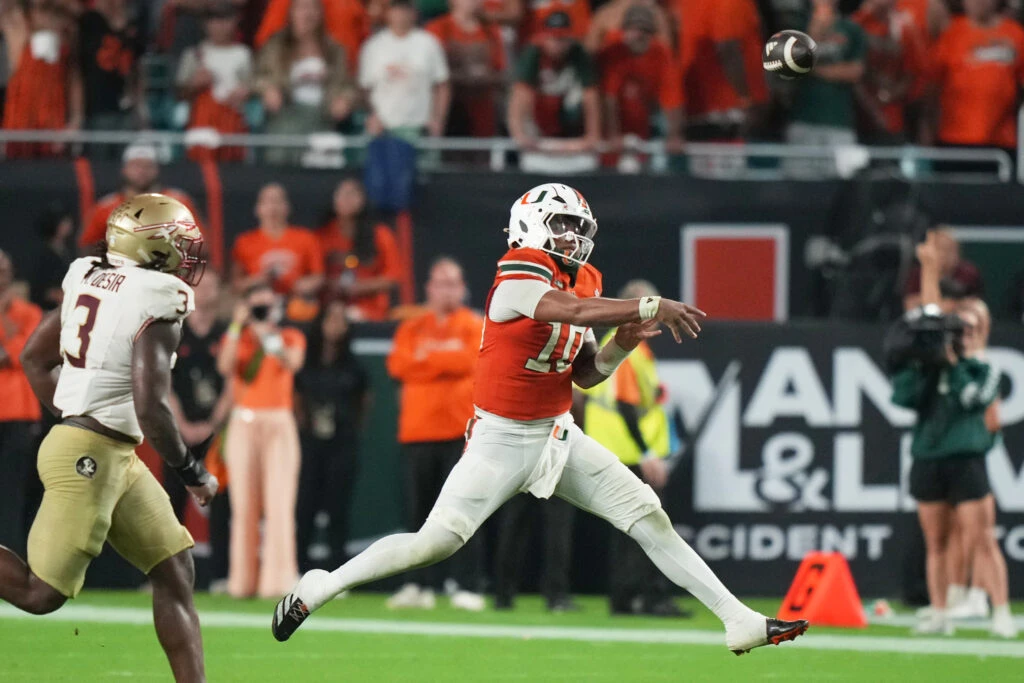
The Hurricanes defeated Florida State 43-35 in double overtime at Hard Rock Stadium, overcoming a determined effort from their longtime rivals.
Quarterback Darian Mensah completed 23 of 34 passes for 326 yards and three touchdowns, while wide receiver Malachi Toney delivered an outstanding performance with 11 receptions for 154 yards.
The decisive sequence came in the second overtime.
Toney caught a three-yard touchdown pass from Mensah before throwing a successful two-point conversion to Cooper Barkate, extending Miami’s advantage to eight points.
The Hurricanes’ defense then secured the victory when Bryce Fitzgerald intercepted Florida State’s fourth-down pass attempt.
Miami’s ability to withstand pressure while other contenders fell proved particularly significant.
The Hurricanes improved to 6-0 and moved to the top of the AP rankings for the first time since 2002.
According to Miami’s official game recap, the victory highlighted the team’s ability to execute in crucial moments, even when facing adversity.
However, maintaining that position will require continued consistency as the regular season progresses.
Why Week 7 Could Change the Entire Playoff Race
The significance of Week 7 extends well beyond changes to the national rankings.
With the College Football Playoff now featuring 12 teams, a single loss no longer carries the same consequences it once did under the previous four-team system.
Nevertheless, every defeat influences a team’s chances of earning favorable seeding, securing a first-round bye, or hosting a postseason game.
Georgia, Notre Dame, and Indiana remain realistic playoff contenders despite their first losses. However, their paths to the postseason have become more complicated.
Each program must now demonstrate that its defeat was an isolated setback rather than evidence of deeper weaknesses.
At the same time, teams such as BYU, Ohio State, and Miami have strengthened their positions through important victories.
The selection committee will eventually need to compare programs with different schedules, conference records, and quality wins.
That process becomes particularly challenging when teams from highly competitive conferences accumulate losses against strong opponents while undefeated programs from other conferences continue building their résumés.
Importantly, the AP rankings do not determine the official playoff field.
The College Football Playoff Selection Committee will release its first rankings on November 3, 2026, before announcing the final bracket on December 6.
Until then, every remaining major matchup has the potential to reshape the national championship picture.
Understanding the 2026-27 College Football Playoff Format
The expanded playoff structure creates more opportunities for teams to compete for the national championship, but several important rules determine how the 12-team field is selected.
According to the College Football Playoff’s official format, the field includes automatic qualification for the champions of the ACC, Big Ten, Big 12, and SEC.
An additional automatic bid is awarded to the highest-ranked team from the American, Conference USA, Mid-American Conference, Mountain West, Pac-12, or Sun Belt.
The remaining seven positions are generally allocated to the highest-ranked eligible teams that did not receive automatic qualification.
Notre Dame also has a specific provision: the independent program is guaranteed a playoff place if it finishes among the top 12 teams in the final CFP rankings. If Notre Dame qualifies through this provision, the number of other at-large places is reduced to six.
Once the 12 teams are selected, the four highest seeds receive first-round byes.
Teams seeded fifth through twelfth compete in first-round matchups, with the higher-seeded programs hosting games at their home stadiums or designated venues.
The winners advance to the quarterfinals, where they face the four teams that received byes.
Unlike some other playoff systems, the bracket remains fixed after Selection Day, meaning teams are not reseeded between rounds.
Another important change for the 2026-27 season involves bowl assignments.
The top three seeds now have the opportunity to select their preferred playoff bowl paths in ranking order, following the removal of historic conference bowl tie-ins.
These adjustments make regular-season positioning especially valuable, even for teams that have already secured a likely postseason appearance.
ESPN Experts Disagree on Who Will Reach the National Championship
The uncertainty surrounding the playoff race is reflected in the latest postseason predictions from ESPN analysts Kyle Bonagura and Mark Schlabach.
Despite evaluating the same results, the two analysts have developed substantially different projections for the national championship.
Bonagura projects a championship matchup between BYU and Miami, reflecting confidence in two programs that emerged from Week 7 with undefeated records and considerable momentum.
BYU’s victory over Notre Dame demonstrated its ability to compete against elite opposition, while Miami’s double-overtime win over Florida State reinforced its reputation as a team capable of surviving difficult situations.
Schlabach, meanwhile, projects Georgia facing Miami in the championship game.
His prediction suggests that Georgia remains a serious title contender despite its defeat to Auburn.
The Bulldogs possess the talent and experience to recover from a regular-season setback, although they must avoid further costly losses.
Both analysts include Miami in their projected title game, highlighting the growing belief that the Hurricanes could be among the strongest teams in the country.
The differing projections also demonstrate why the playoff race remains difficult to predict.
Strength of schedule, head-to-head results, conference championships, and overall performance can all influence how teams are evaluated.
Fans can review the complete projections in ESPN’s Week 7 College Football Playoff and bowl predictions.
The Key Dates That Will Decide the 2026-27 National Championship
Following the dramatic events of Week 7, attention now turns toward the remaining regular-season schedule and the official playoff selection process.
The first College Football Playoff rankings will be released on November 3, providing the earliest indication of how the selection committee views the leading contenders.
The final rankings and complete 12-team bracket will be announced on December 6.
Postseason competition begins with the first-round games on December 18 and 19, when eight teams will compete for four places in the quarterfinals.
The Fiesta Bowl will host the first quarterfinal on December 30, followed by three additional quarterfinal games on January 1, 2027, at the Cotton Bowl, Peach Bowl, and Rose Bowl.
The semifinal stage begins on January 14 at the Orange Bowl in Miami Gardens, Florida.
The second semifinal follows on January 15 at the Sugar Bowl in New Orleans, Louisiana.
The championship game is scheduled for January 25, 2027, at Allegiant Stadium in Las Vegas, Nevada, with kickoff set for 7:30 p.m. Eastern Time.
The complete schedule, including broadcasting information, is available through the official College Football Playoff website.
A Championship Race That Is Suddenly Wide Open
Week 7 served as a powerful reminder that college football’s national championship race can change dramatically in a matter of hours.
Georgia’s unexpected defeat, Notre Dame’s loss to BYU, and Indiana’s setback against Ohio State dismantled much of the established playoff hierarchy.
Meanwhile, Miami emerged as the nation’s new top-ranked team, BYU strengthened its credentials as a legitimate contender, and Ohio State gained valuable momentum.
The expanded 12-team playoff provides opportunities for teams to recover from setbacks, but it also makes favorable seeding and conference championship results increasingly important.
With several weeks remaining before the selection committee announces its final decisions, the race remains far from settled.
If Week 7 demonstrated anything, it is that no program can afford to take its position for granted.
The journey to the 2027 national championship has become considerably more unpredictable, and the most consequential games of the season may still be ahead.