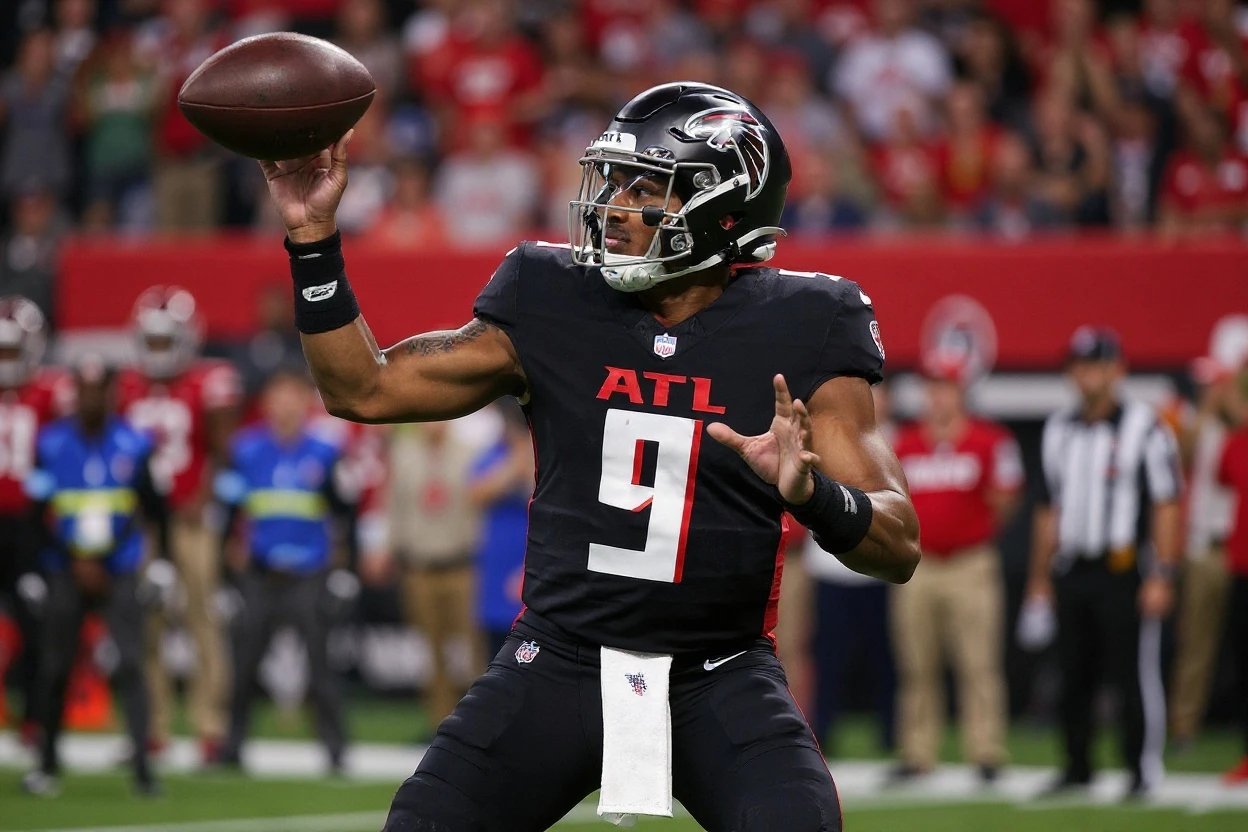
Michael Penix Jr. arrived in Atlanta as the most polarizing first-round pick of the 2024 NFL Draft — selected eighth overall just days after the Falcons signed Kirk Cousins to a four-year, $180 million deal.
The optics were confusing from the start, but the plan was always to develop Penix behind Cousins and eventually hand him the franchise quarterback role.
That plan accelerated dramatically when Cousins’ performance declined and the Falcons moved on from their expensive veteran, but now Penix’s own injury has thrown Atlanta’s quarterback situation back into chaos at the worst possible time.
- Michael Penix Jr. was selected eighth overall in the 2024 NFL Draft, making him one of the most expensive developmental quarterback investments in recent memory
- Kirk Cousins’ $180 million deal created an unprecedented financial and roster management challenge for Atlanta’s front office
- Penix’s injury has reopened questions about the Falcons’ quarterback depth and their ability to compete in the NFC South
- Atlanta’s backup options are limited, and the organization faces difficult decisions about how to manage the situation
- The Falcons’ investment in Penix represents a long-term commitment that makes trading or moving on from him extremely unlikely
- Recovery timeline and the nature of the injury will determine how much of Atlanta’s season is affected
How Atlanta Got Here: The Cousins-Penix Saga Explained
The $180 Million Mistake That Set Everything in Motion
To understand the full weight of Penix’s injury, you need to understand the financial and organizational context that preceded it.
In March 2024, the Atlanta Falcons signed Kirk Cousins to a four-year, $180 million contract, as reported by Fox News — one of the largest deals ever given to a quarterback entering his age-36 season.
The contract included $100 million guaranteed, a figure that reflected the Falcons’ desperation to find a stable starting quarterback after years of instability at the position.
Four days later, Atlanta used the eighth overall pick in the 2024 NFL Draft, per the NFL’s official announcement, to select Michael Penix Jr. out of Washington.
The decision drew immediate criticism from analysts and fans who questioned why a team that had just committed $180 million to a veteran quarterback would spend a top-10 pick on a developmental signal-caller.
The Falcons’ front office, led by general manager Terry Fontenot, maintained that the plan was always to develop Penix as the long-term answer while Cousins served as a bridge.
For a detailed look at how the Cousins situation unraveled in Atlanta, the full breakdown of the $180 million mistake provides essential context.
Cousins’ Decline and Penix’s Promotion
Cousins’ performance in Atlanta never matched the investment.
He struggled with consistency, dealt with injury, and failed to elevate the Falcons to the level of NFC contender that the contract was supposed to facilitate.
The organization eventually made the decision to move on from Cousins and hand the starting job to Penix — a transition that was always part of the long-term plan, just accelerated by circumstances.
Penix showed enough in his early starts to justify the optimism surrounding his selection, demonstrating the arm talent and mobility that made him a top-10 pick.
But the transition from developmental prospect to franchise starter is never seamless, and Penix was still in the process of establishing himself as Atlanta’s unquestioned starter when the injury struck.

The Injury: What Happened and What It Means
The Nature of the Setback
Penix’s injury represented a significant blow to a Falcons team that had already invested enormous resources — both financial and in draft capital — in his development.
The timing of the injury, coming during a period when Atlanta was attempting to establish Penix as the foundation of their offensive identity, made it particularly damaging.
Quarterback injuries at the NFL level are never routine, and the specific nature of Penix’s setback placed his availability in question for a meaningful portion of the season.
The Falcons’ medical staff and coaching staff faced the challenge of managing his recovery while simultaneously preparing backup options to keep the team competitive during his absence.
Atlanta’s Backup Quarterback Situation
The depth chart behind Penix was not built to handle an extended absence from the starter.
NFL teams rarely invest significant resources in backup quarterbacks, and the Falcons were no exception — their options behind Penix were limited in terms of both experience and proven production at the NFL level.
The challenge for head coach Raheem Morris and offensive coordinator Zac Robinson was designing a game plan that could function without Penix’s specific skill set — his ability to throw with anticipation, his mobility in the pocket, and his arm strength on deep routes.
Backup quarterbacks, by definition, are not equipped to replicate what a franchise starter provides, and the Falcons’ offense was going to look different — and likely less effective — without Penix under center.
The Financial Reality: Why the Falcons Can’t Simply Move On
One of the most important aspects of the Penix situation is the financial commitment Atlanta has made to him.
A top-10 pick in the NFL Draft carries a four-year rookie contract with a fifth-year option, and the Falcons’ decision to select Penix eighth overall means they are locked into his development regardless of short-term setbacks.
The organization cannot simply pivot to a different quarterback solution without absorbing the sunk cost of that draft investment — and given the circumstances surrounding the Cousins contract, the Falcons have already demonstrated a willingness to absorb significant financial pain at the quarterback position.
The practical reality is that Penix is Atlanta’s quarterback of the future, injury or not.
The organization’s path forward runs through his development, and the injury represents a detour rather than a dead end.
But detours have consequences in the NFL, where the margin between contention and mediocrity is measured in wins and losses that accumulate during a quarterback’s absence.
The NFC South Implications
The NFC South has been one of the most volatile divisions in the NFL over the past several seasons, with no team establishing the kind of sustained dominance that makes divisional races predictable.
Atlanta’s ability to compete in the division during Penix’s absence depends on the performance of their defense and the collective effort of a roster that was built to support a young quarterback, not to carry the team without one.
The Falcons’ defense, which has shown flashes of quality under Morris, would need to elevate its performance to compensate for the offensive limitations created by Penix’s absence.
In a division where the Tampa Bay Buccaneers, New Orleans Saints, and Carolina Panthers all have their own roster questions, Atlanta’s ability to stay competitive during a quarterback injury is not impossible — but it requires near-perfect execution in areas outside of the passing game.
What Penix’s Injury Reveals About Atlanta’s Roster Construction
The Falcons’ vulnerability at the backup quarterback position is a reflection of broader roster construction decisions that prioritized other areas of the team.
NFL teams face constant tradeoffs in how they allocate salary cap space and roster spots, and the decision to invest heavily in skill position players and the offensive line around Penix left the depth chart behind him thin.
That approach makes sense when the starter is healthy — you build the team around your franchise quarterback and trust that he stays on the field.
But when the starter goes down, the lack of investment in backup quarterback depth becomes immediately apparent.
The Falcons’ front office will need to evaluate whether their approach to quarterback depth needs to change going forward, particularly given Penix’s injury history at the college level — he dealt with significant injuries at Indiana and Washington before being drafted, which was a known risk factor when Atlanta selected him eighth overall.
Penix’s College Injury History and What It Means for His NFL Durability
Michael Penix Jr.’s college career was defined as much by his resilience as by his talent.
He suffered torn ACLs in both knees during his time at