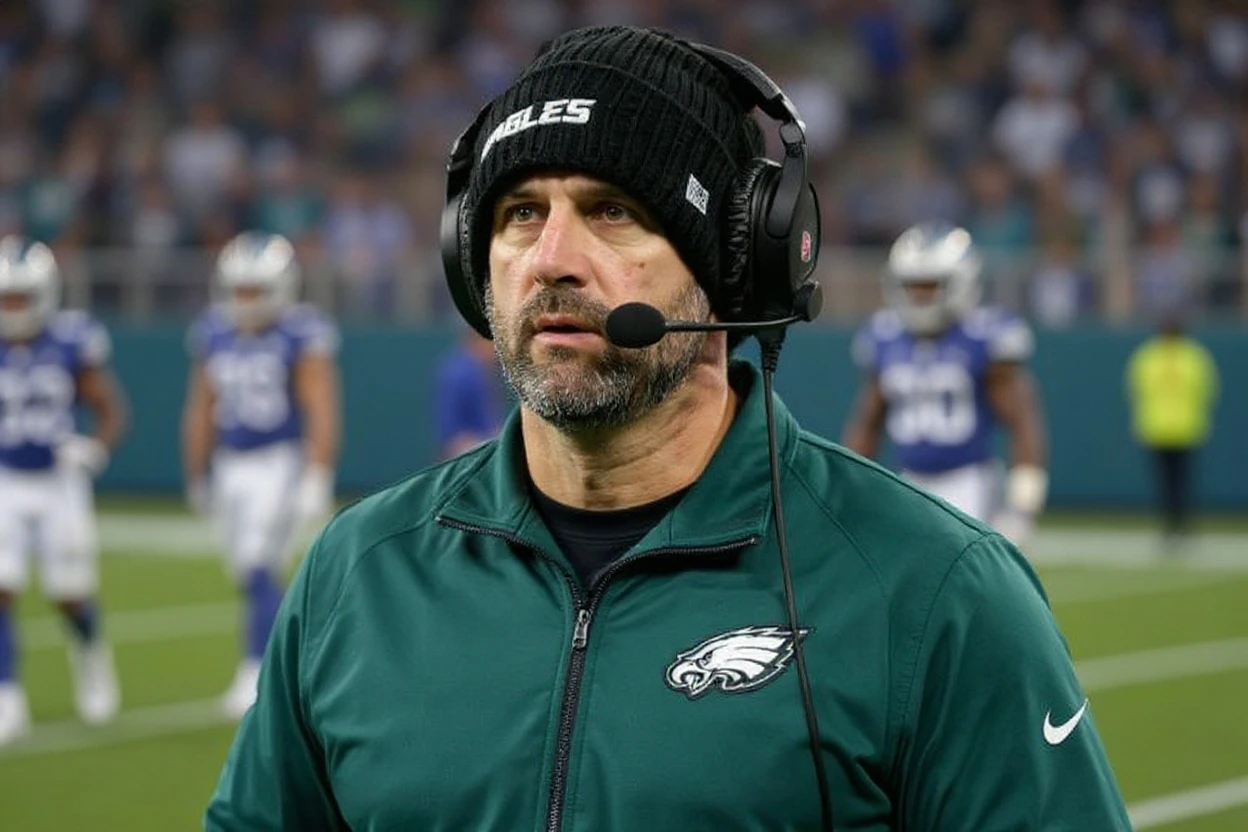
Despite recent offensive struggles, Philadelphia Eagles head coach Nick Sirianni remains steadfast in his support for offensive coordinator Kevin Patullo, dismissing any potential changes to the team’s play-calling duties.
Sirianni Stands Firm: No Changes to Eagles’ Play-Calling
Philadelphia Eagles head coach Nick Sirianni is standing behind offensive coordinator Kevin Patullo despite a season-long pattern of offensive inconsistency — publicly dismissing any suggestion that play-calling responsibilities will change hands.
Nick Sirianni isn’t flinching. With the Philadelphia Eagles sitting on one of the most talent-loaded rosters in the NFC and an offense that has repeatedly failed to match that talent level, the head coach is publicly backing offensive coordinator Kevin Patullo and closing the door on any mid-season restructuring of play-calling duties. The message from Sirianni is unambiguous: Patullo stays, and the solution will come from within the current structure.
Offensive Woes: Digging Deeper into the Numbers
Sirianni’s defense of Patullo carries real weight precisely because of what surrounds it. Philadelphia returned 10 of 11 offensive starters from a Super Bowl roster, made a deliberate organizational commitment to continuity, and entered 2024 as a legitimate NFC title contender. The gap between that roster pedigree and the offense’s actual production has grown impossible to ignore, and Sirianni’s continued public support for his coordinator is now one of the more scrutinized decisions of his tenure.
The breaking point arrived in Week 12, when Philadelphia dropped a 24-21 decision to the Dallas Cowboys — a game the Eagles controlled for stretches and ultimately surrendered in the final minutes. When reporters pressed Sirianni directly about Patullo’s status after the loss, the head coach offered no hedging: play-calling responsibilities are not changing.
The Cowboys loss didn’t create the problem — it exposed it. Philadelphia’s offense went stagnant across seven consecutive drives during the game’s critical stretch, unable to generate the kind of sustained pressure that forces opposing defenses into difficult adjustments. Sirianni acknowledged the execution breakdowns in his postgame remarks but was deliberate in framing the failures as collective rather than pinning them on his coordinator’s decision-making.
“Yesterday, I felt Kevin did a good job of calling it. Obviously, he’s going to want plays back,” Sirianni said.
Rather than identifying play-calling as the primary source of the offense’s struggles, Sirianni positioned the issues as systemic — a breakdown distributed across scheme design, in-game adjustments, and individual execution that no single personnel change would resolve on its own.
Patullo’s Position: A Coaching Conundrum
“We’re never into assigning blame. It’s just looking for answers. I think what sometimes can happen is, ‘It’s just that!’ Well, it’s not just that. It’s every piece of the puzzle — coaching, playing, execution, scheme. Everything. We’ve got to be better in all those aspects,” Sirianni explained.
That framing is defensible, but it comes with a shrinking shelf life. Distributing accountability across the entire operation works as a short-term narrative when the team is trending upward. With the regular season window closing and the playoff bracket taking shape, the collective-failure argument will face mounting pressure if the efficiency numbers don’t move. At some point, the coordinator conversation stops being a media storyline and becomes an organizational one.
The underlying statistics reveal an offense that produces volume without producing results — and in the NFL, that distinction separates playoff contenders from early exits.
Philadelphia has accumulated 4,059 total yards on the season, a number that reads as respectable in isolation. Add the efficiency layer and the picture shifts. The Eagles rank 17th in EPA (Expected Points Added) per drive — a metric widely used by analysts and front offices as one of the most reliable measures of offensive quality because it accounts for field position, down-and-distance context, and scoring outcomes rather than raw yardage accumulation. For a team with Super Bowl aspirations and a dual-threat quarterback in Jalen Hurts, sitting in the bottom half of the league in EPA per drive is a significant red flag.
Continuity Conundrum: Familiar Faces, Unfamiliar Struggles
The split-level data makes the case even harder to defend. Philadelphia ranks 24th in yards per game, 17th in points per game with 321 total points scored, 21st in rushing at 1,459 yards, and 23rd in passing at 2,600 yards. The third-down numbers are the most damaging data point in the entire offensive profile: the Eagles rank 27th in conversion rate, converting just 60 of 179 attempts, and sit dead last — 32nd in the NFL — in three-and-punt rate, having punted 68 times for 3,425 yards. For an offense built around Hurts’ ability to extend plays and create with his legs, a 32nd-place ranking in three-and-punt rate represents a fundamental failure to leverage the team’s most important competitive asset.
There are legitimate bright spots in the data, but their impact is limited by context. Philadelphia has been disciplined with the football, committing just 11 fumbles and four interceptions — a turnover profile that reflects well on Hurts and an offensive line that has consistently protected possession. Red zone efficiency is also a genuine strength: the Eagles have converted 26 of 34 trips inside the opponent’s 20-yard line into touchdowns, a conversion rate that ranks among the better marks in the league. The problem is that red zone production only matters when you’re getting there at a consistent rate, and Philadelphia’s inability to sustain drives is the bottleneck that’s suppressing the entire operation’s ceiling.
What makes Sirianni’s current stance particularly striking is how sharply it contrasts with his own track record of in-season accountability. In December 2023, as The Philadelphia Inquirer reported, he stripped defensive coordinator Sean Desai of play-calling duties mid-season — a move that signaled a willingness to make uncomfortable personnel decisions in real time when performance demanded it. He then fired offensive coordinator Brian Johnson at the conclusion of that same season after the offense failed to deliver in the postseason, as NFL.com confirmed. Those two decisions established Sirianni as a head coach who would pull the trigger when results required it.
The Waiting Game: Will Sirianni’s Patience Pay Off?
That established pattern makes his current position with Patullo harder to read. Either Sirianni has genuine confidence that his coordinator can self-correct within the existing structure, or he’s making a calculated bet that the sheer talent on this roster will eventually override the schematic inconsistencies that have plagued the offense all season. Both are plausible explanations. But the standard he set with those previous moves means the Patullo situation will not stay quiet if the numbers don’t improve — and the Eagles’ own history suggests Sirianni knows that better than anyone.
“As coaches, we’re always looking for answers,” Sirianni said. With 827 total plays run on the season and an EPA-per-drive ranking that sits in the bottom half of the league, the urgency behind that search is accelerating. The regular season window to correct this offense before the playoffs is closing fast, and on a roster assembled with championship-level investment, the margin for continued underperformance has effectively run out.
The stakes of Sirianni’s decision are amplified by how deliberately Philadelphia constructed this offense heading into the season. This was not a roster in transition or a group still finding its identity — it was a unit built specifically to build on a Super Bowl run and compete for a title in 2024.
Patullo’s working relationship with Hurts dates back to 2021, giving the two one of the longer-tenured coordinator-quarterback partnerships currently active in the NFL. The organizational logic was straightforward: a coordinator who understands his quarterback’s tendencies, reads, and physical limitations as thoroughly as Patullo understands Hurts should be positioned to design an offense that maximizes every weapon on the field. Familiarity, in theory, should translate directly into efficiency.