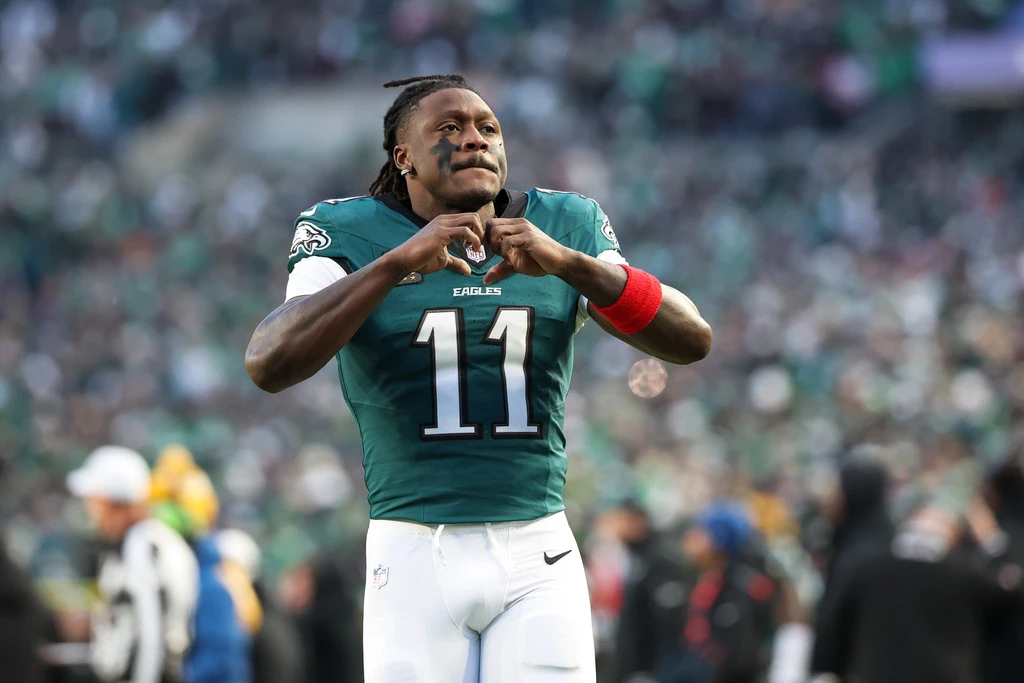
As the NFL trade deadline approaches, speculation surrounding the potential departure of star wide receiver A.J. Brown from the Philadelphia Eagles has reached a fever pitch.
Trade deadline season has a way of separating real roster instability from manufactured noise — and right now, the speculation surrounding A.J. Brown’s future with the Philadelphia Eagles is generating the kind of sustained, multi-source attention that front offices cannot simply wait out.
Blockbuster Trade Rumors Swirl Around A.J. Brown
What started as peripheral chatter has hardened into one of the most closely tracked roster storylines in the NFC. Multiple reports have surfaced indicating genuine trade interest in Brown from outside organizations, and the volume of that interest has not faded as the deadline approaches. This is no longer background noise — it is a developing situation with real implications for one of the league’s reigning Super Bowl champions.
The Eagles entered the 2025 season as Super Bowl LIX champions, and Brown was a central piece of that run — a physical mismatch nightmare who gave Jalen Hurts a reliable target in contested situations throughout the postseason. Yet despite the championship banner and a publicly unified organizational front, the persistence and specificity of trade rumors surrounding the 6-foot-1, 226-pound receiver have made it increasingly difficult for even the most loyal Philadelphia fans to dismiss the possibility outright.
Philadelphia’s front office has pushed back firmly on any suggestion that Brown is available. Multiple team officials have gone on record to reinforce that message, and the organization has consistently characterized the situation as stable. But in a league where front offices routinely manage public narratives while quietly exploring options behind closed doors, a single denial — however emphatic — cannot fully neutralize the weight of persistent, multi-source reporting. The NFL’s history is littered with players who were “not available” right up until the moment they were traded.
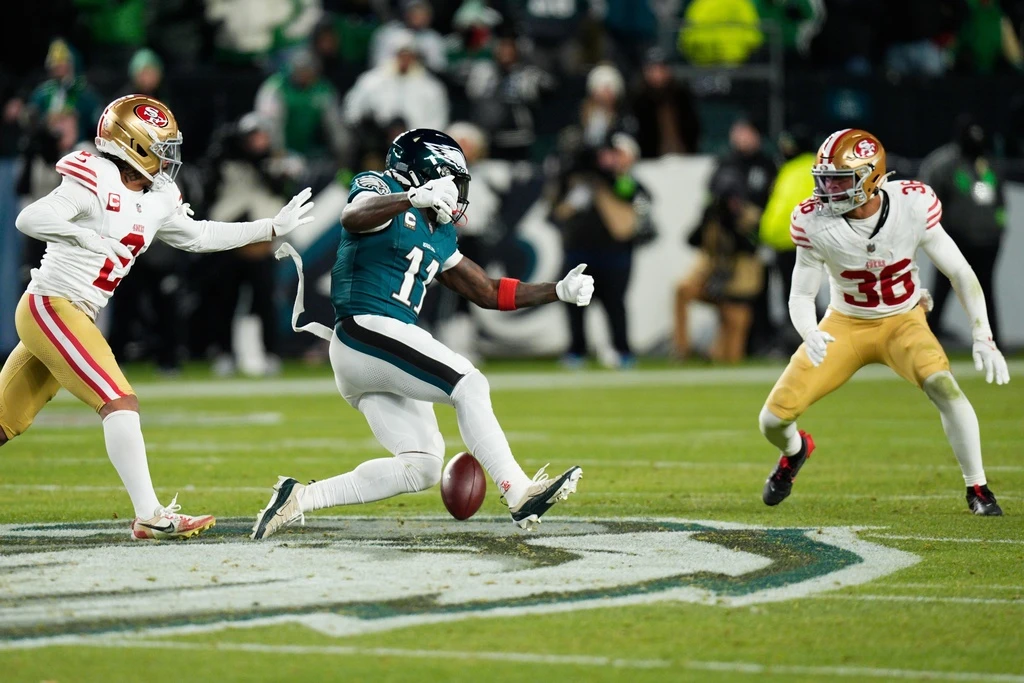
The Curious Case of A.J. Brown’s Cryptic Posts
Brown’s name surfacing in trade discussions is not a minor storyline. He is one of the most physically imposing and productive wide receivers in the NFL — 6-foot-1, 226 pounds, per the NFL’s official listing, with the route-running precision and contested-catch ability to match his size — and has been a cornerstone of Philadelphia’s offense since arriving via trade from the Tennessee Titans in April 2022. Any deal involving him would immediately rank among the most consequential receiver trades in recent NFL history, comparable in scope to the Davante Adams move to Las Vegas in 2022, which cost the Packers two first-round picks and a second.
Two factors are driving the speculation. First, Brown’s social media activity has included posts that fans and analysts have widely interpreted as expressions of frustration — vague enough to deny, specific enough to invite scrutiny. Second, broader questions have emerged about his fit within offensive coordinator Kellen Moore’s system, particularly as the Eagles’ offensive identity has shifted to accommodate Saquon Barkley’s dominant presence in the backfield. Whether Brown’s posts reflect genuine discontent or simply the competitive edge of an elite player who demands more from himself and those around him is debatable — but they have kept the rumor cycle running at full speed.
The statistical case for keeping Brown is hard to argue against. He posted 81 receptions for 1,028 receiving yards and 7 touchdowns in the most recent season, clearing the 1,000-yard mark for the fourth time in his career. Trading a receiver of that caliber mid-cycle — one who is under contract, producing at an elite level, and entering his prime years — would be an unusual and aggressive move for a franchise that just won a championship. Historically, Super Bowl champions rarely dismantle core offensive weapons in the immediate aftermath of a title run.
Will the Eagles Keep Their Star Receiver?
Brown’s social media presence has become a storyline in its own right. Several posts during the season were deliberately ambiguous, and in today’s NFL media environment, that ambiguity is enough to generate a full news cycle. Reporters and analysts have parsed the language carefully, looking for signals about his relationship with the coaching staff and front office. The fact that those posts have continued — rather than tapering off as the season progressed — has done nothing to quiet the conversation or reassure observers that everything inside the building is as settled as the organization claims.
The Eagles’ official response has been consistent: there is no issue. The organization has framed Brown’s public expressions as nothing more than the competitive intensity of a player who holds himself and his teammates to a high standard. But the gap between what organizations say publicly and what they discuss internally is well-documented across the league, and skeptics have not been fully satisfied by the party line — particularly given how frequently these situations have escalated elsewhere in recent years. Antonio Brown in Pittsburgh, Odell Beckham Jr. in Cleveland, and Davante Adams in Green Bay all followed similar trajectories before eventual departures.
What makes the speculation harder to dismiss is the production data itself. Brown’s 81 receptions and 1,028 receiving yards came with a yards-per-game average of 56.4 — a career low for his time in Philadelphia. For a receiver of Brown’s ability and physical profile, that number stands out as a potential point of friction, and it has prompted legitimate questions about whether Moore’s system is deploying him as efficiently as possible. Usage patterns, not just raw totals, matter when evaluating a player of his caliber — and the usage trend is moving in the wrong direction.
Despite the noise, Philadelphia’s front office has not wavered publicly. General manager Howie Roseman has built one of the most aggressive and creative roster management reputations in the league — engineering the original Brown trade, the Saquon Barkley signing, and multiple draft-day maneuvers that have kept the Eagles consistently competitive — but he has also demonstrated a willingness to commit to core players when the situation calls for it. By most accounts, Brown still falls into that category. But Roseman’s track record also includes a willingness to move on when the calculus shifts.
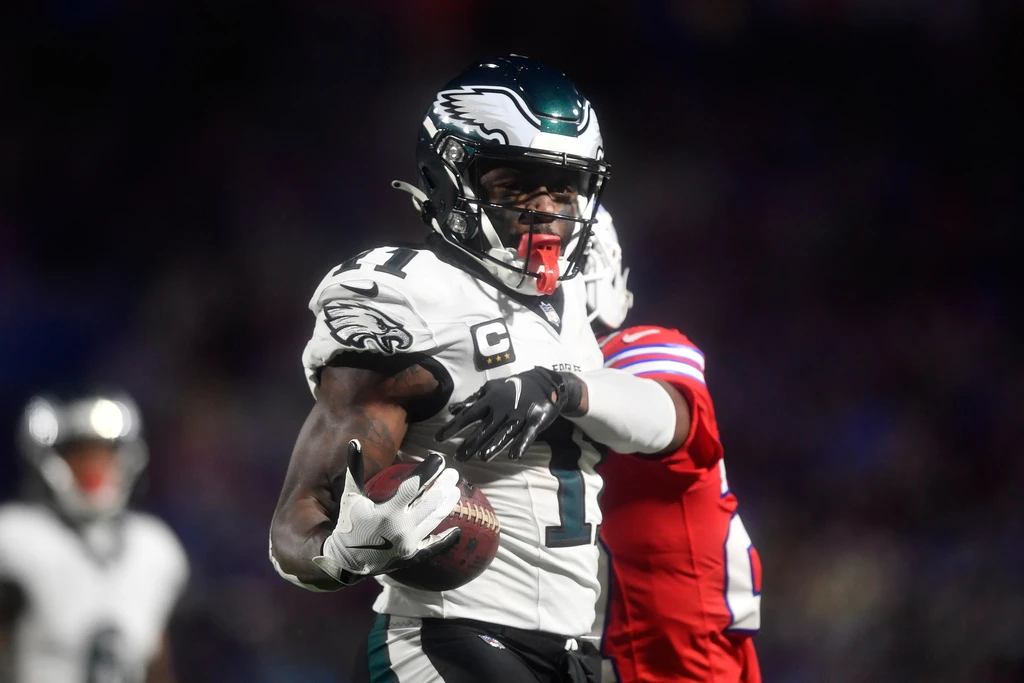
Inside A.J. Brown’s Frustrations This Season
Head coach Nick Sirianni has addressed the rumors directly on multiple occasions, framing the situation as business as usual and emphasizing team cohesion. Whether that message has fully landed inside the locker room is harder to assess from the outside, particularly given the compressed timeline of a trade deadline window and the reality that players talk — regardless of what coaches say at the podium.
The more pressing question is what it would actually take to move Brown if the Eagles ever opened that door. A receiver who clears 1,000 yards, catches 7 touchdown passes, and presents the kind of physical matchup problems Brown creates on a weekly basis commands a significant return — likely multiple first-round picks or a combination of premium draft capital and an established starter at a position of need. That kind of offer rarely materializes at the deadline, which is a primary reason most analysts still view a trade as unlikely before the window closes. The Davante Adams trade set a market benchmark; any Brown deal would need to approach or exceed it.
That said, the Eagles are not immune to the logic of roster construction. If a team presented an offer that meaningfully accelerated Philadelphia’s ability to build depth along the offensive line, at pass rusher, or in the secondary, Roseman has the track record to at least run the numbers. The franchise’s long-term calculus is always more complex than any single player’s value in isolation — and Roseman has never been sentimental when the math pointed in a different direction. His willingness to trade up, trade down, and restructure contracts on the fly is well-established.
The deeper layer of this story involves how the offense deploys Brown relative to his strengths. The Eagles run a scheme that distributes targets across multiple weapons, and in a season where Saquon Barkley emerged as arguably the most dominant offensive player in the league — finishing with over 2,000 rushing yards, as documented by Britannica, and a significant receiving role out of the backfield — the ball distribution shifted accordingly. Brown absorbed the downstream effects of that shift more than any other skill-position player on the roster, and the numbers reflect it.
The High-Stakes Saga of A.J. Brown’s Future
Brown has not made explicit public statements demanding more targets, but the subtext of his social media activity and reported sideline demeanor has led analysts to connect those dots. A receiver who averaged 17.3 yards per catch in his first Eagles season and drew 145 targets in 2022 has seen his role evolve — and not necessarily in a direction that maximizes his strengths as a contested-catch, big-play threat. The shift is real and measurable, even if the reasons behind it are more complex than any single narrative captures.
The yards-per-game figure of 56.4 is the number that keeps surfacing in these discussions. For context, Brown averaged 73.4 yards per game in his first Eagles season and 75.6 in 2023. The decline is real and measurable, even if the raw yardage total still clears 1,000. Whether that reflects scheme design, deliberate usage decisions, or something more structural is the question the Eagles need to answer internally — and the answer to that question may ultimately determine whether Brown is in Philadelphia beyond this season. A player of his caliber does not quietly accept a diminished role indefinitely.
Jalen Hurts finished the season with 3,392 passing yards and 26 touchdown passes, adding 435 rushing yards and 8 rushing scores — numbers that confirm his standing as one of the NFL’s most complete quarterbacks. Barkley’s presence as a receiving threat out of the backfield further compresses the target distribution across the skill group. In that offensive environment, Brown’s role has become more defined and, by the numbers, more limited than it was during his first two seasons in Philadelphia — a reality that shapes every conversation about his future and gives outside teams a legitimate opening to make their pitch.
The trade deadline is the forcing function that turns background speculation into real decisions. For the Eagles, the next few weeks will require internal clarity on where Brown stands — not just in the public messaging, but within the organization’s genuine long-term plans. Every day the front office stays silent on the substance of these reports gives outside teams more time to structure offers and gives the story more oxygen. At some point, managing the narrative requires more than a denial.