
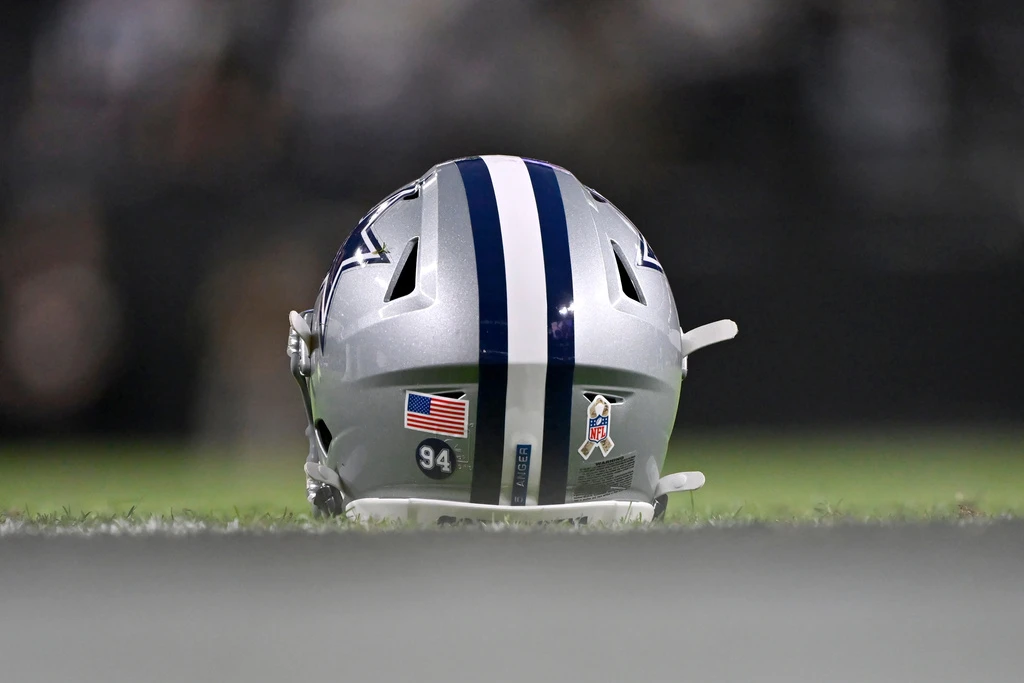
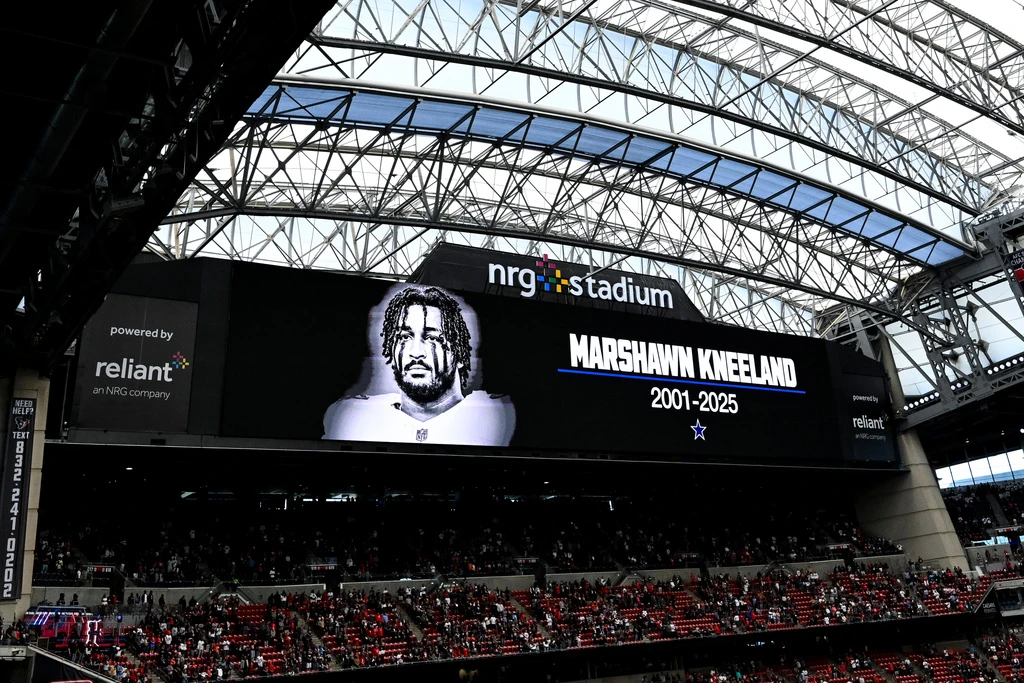
The sudden death of Marshawn Kneeland in Frisco, Texas, on November 6, 2025, as CBS Sports reported, sent shockwaves through the NFL. At just 24 years old, the Dallas Cowboys defensive end appeared to have everything—talent, opportunity, and a professional platform at sports’ highest level.
He was in his second season, establishing himself as a promising defensive prospect.
Across 11 games in his 2024 rookie season, Kneeland recorded 17 tackles, including 2 tackles for loss, 13 quarterback pressures, 1 pass breakup, and 1 fumble recovery—a statistical profile suggesting remarkable potential and steep upward trajectory. Yet beneath the surface of his career, an invisible battle was unfolding
In July, the Concussion and CTE Foundation announced a diagnosis that reframed the tragedy entirely: Kneeland had developed Stage 1 chronic traumatic encephalopathy based on post-mortem brain tissue analysis.
What emerged revealed a condition that had been silently developing throughout his years on the field. Kneeland’s case has become emblematic of a broader crisis rippling through contact sports globally.
Recent epidemiological findings reveal that former NFL players show CTE at staggering rates, while professional soccer players face dementia risks significantly elevated above the general population.
These statistics transform Kneeland’s tragedy from an isolated incident into evidence of systemic vulnerability affecting athletes across multiple sports—a vulnerability demanding immediate institutional response.
What Is Stage 1 CTE, and Why Did No One Catch It?
Boston University researchers at the CTE Center made a sobering discovery: Kneeland had developed Stage 1 chronic traumatic encephalopathy, a degenerative brain condition triggered by repetitive head impacts. This diagnosis revealed a critical flaw in modern sports medicine.
Dr. Ann McKee and Dr. Chris Nowinski confirmed what many in the medical community already knew but hadn’t adequately communicated to athletes—‘Mr. Kneeland played in the modern era of concussion protocols and better helmets, and yet he still developed CTE,’ said Dr. Chris Nowinski, Concussion & CTE Foundation CEO. ‘We have no reason to believe the current generation is at a lower risk of CTE than previous generations. Concussion protocols do not prevent CTE, because CTE is caused by repeated head impacts, not just concussions. If we want to reduce CTE risk, we must implement CTE prevention protocols and aggressively reduce the number and strength of head impacts at every level of the game.’
They address immediate concussive injuries, but they leave a gaping void in long-term protection against accumulating subconcussive blows.
CTE develops subclinically, meaning damage accumulates without obvious symptoms until advanced stages emerge.
The condition affects the brain’s structure at the cellular level, progressively worsening over years.
Medical experts increasingly recognize that CTE prevention protocols may be equally or more critical than concussion protocols, particularly because they target the repeated, seemingly minor impacts that cause lasting neurological harm.
This raises a haunting question: how many other players are developing this condition right now, unaware and unprotected?
The Timeline: How Years of Tackles Led to This Moment
Kneeland’s exposure to repeated head impacts began remarkably early. At age seven, he started playing tackle football, beginning a journey spanning nearly two decades.
Through his youth and adolescent years, every practice, every game, every collision contributed to cumulative trauma in his developing brain.
During high school, impacts intensified as competition became more aggressive. He continued at Western Michigan University, where collegiate football demands elevated physical commitment and where he refined the defensive techniques defining his professional identity.
Then came the culmination—the 2024 NFL Draft, where the Dallas Cowboys selected him in the second round, as Western Michigan Athletics noted.
By the time he reached professional football, the neurological groundwork for his condition was already established.
What makes this timeline particularly troubling is that during each phase of his athletic journey, accumulating damage was occurring invisibly.
Coaches, trainers, and medical staff focused on immediate injuries, missing the larger picture unfolding in his brain.
Recent institutional responses from other sports organizations underscore the inadequacy of current youth protection.
Leading soccer unions have implemented comprehensive protocols preventing children under 12 from heading at all and limiting professional players to no more than 10 headers weekly—recognition that early intervention across an athlete’s lifetime is essential.
Such proactive measures were absent throughout Kneeland’s formative years in football.
The Cruel Complexity: Why CTE Isn’t the Whole Story—But Part of It
Medical experts are careful to emphasize an important reality: suicide results from complex, multifactorial causes, and CTE alone does not cause suicide.
The Concussion & CTE Foundation has been explicit about this distinction based on the post-mortem analysis identifying Kneeland’s Stage 1 CTE diagnosis.
However, context matters profoundly. CTE fundamentally alters brain function in ways directly relevant to mental health and decision-making.
The condition affects mood regulation, impulse control, and judgment—neurological functions directly influencing vulnerability to suicidal thoughts.
For someone already struggling with depression, anxiety, or other psychological challenges, the presence of a degenerative brain condition compounds vulnerability exponentially.
Kneeland’s case represents the tragic intersection of diagnosed brain injury and underlying mental health struggles, complicated further by the loss of his mother in February 2024, just two months before his professional debut—a significant personal trauma occurring precisely as his career began.
It suggests he was fighting battles on multiple fronts—some visible and deeply personal, others neurological and invisible.
This multifactorial reality underscores why systemic protection must address both immediate safety protocols and mental health support.
The Reckoning: What the NFL Must Do Now
Kneeland’s posthumous diagnosis demands systemic change. The NFL has possessed substantial evidence for years that repeated head impacts cause lasting neurological damage, yet prevention strategies remain woefully inadequate.
Current concussion protocols represent a minimal response to a massive problem. The time for incremental adjustments has passed.
Meaningful reform must include enhanced protective equipment specifically designed to reduce rotational forces, mandatory baseline neuroimaging to establish individual benchmarks before players start professional careers, and honest, comprehensive education about long-term risks beginning in youth football.
Youth and high school programs need substantial resources and oversight. Additionally, the league must invest in longitudinal research tracking players throughout their careers and beyond—data that could have revealed Kneeland’s risk trajectory had such protocols existed. Critical gaps exist in protocol enforcement itself.
Recent investigations have revealed that even established concussion procedures are frequently violated under competitive pressure, with coaching staff and players interrupting medical evaluations and pressuring early return-to-play decisions.
Strengthening enforcement mechanisms and creating buffers against competitive pressure during injury assessment is essential.
Most critically, transparency is non-negotiable. Players deserve complete information about risks before committing to football at any level.
Kneeland’s death represents a failure of systems designed to protect athletes. His legacy demands better.
The Broader Reckoning: How Kneeland’s Diagnosis Reflects a Systemic Crisis
Kneeland’s Stage 1 CTE diagnosis, revealed through post-mortem brain tissue analysis, underscores a sobering reality that extends far beyond his individual tragedy.
The condition could only be definitively identified after his death—a diagnostic limitation that reflects the field’s current inadequacy.
While researchers are exploring promising avenues like Traumatic Encephalopathy Syndrome (TES) to diagnose similar conditions in living patients, these developments remain largely in early stages, leaving the vast majority of active and retired players without meaningful tools for early detection.
The tragic irony is that by the time CTE can be confirmed, it’s too late for intervention.
What makes Kneeland’s case particularly alarming is the trajectory it suggests. At just 24 years old with only two professional seasons behind him, his Stage 1 CTE diagnosis confirms what researchers have long suspected: the damage doesn’t begin in the NFL.
It accumulates throughout an athlete’s entire career, starting in youth leagues and continuing through high school and college.
Historical parallels reinforce this pattern. Other young professional athletes who developed CTE played remarkably brief professional careers, yet still showed advanced brain degeneration—a pattern indicating that significant damage had already occurred during their formative athletic years.
The implication is haunting: numerous current players across youth, high school, and college programs may already be developing this condition silently, completely unaware and entirely unprotected.
The predictability of this outcome reflects a systemic failure that has persisted despite decades of emerging evidence.
Kneeland’s death was not a shocking aberration—it represents the fulfillment of a trajectory set in motion long before he ever became an NFL player.
While individual cases cannot be reduced to statistics, patterns across the profession reveal a consistent picture: the combination of early exposure, accumulated subconcussive impacts, and the absence of meaningful preventive infrastructure creates conditions where tragedy becomes statistically likely rather than tragically surprising.
This recognition should catalyze immediate institutional transformation, not just expressions of sympathy.