Justin Verlander’s retirement closes the book on one of the most dominant and durable pitching careers the modern game has produced — and leaves a rotation-sized hole that no single arm is ready to fill.
The Last of a Dying Breed: Justin Verlander’s Retirement Signals the End of an Era
Verlander officially retired in 2026 after parts of 20 major league seasons, ending a career that, per Baseball-Reference, included three Cy Young Awards, one AL MVP, a World Series title, a no-hitter, and 3,300-plus career strikeouts. His 244 career wins, accumulated across stops in Detroit, Houston, and New York, cement a Hall of Fame case that requires no debate. What his exit also signals is the end of an era — one defined by a standard of sustained ace-level excellence that the current generation of starters has not yet come close to matching.
Verlander’s retirement effectively completes the dissolution of the most accomplished starting pitcher triumvirate of the post-2000 era. He, Clayton Kershaw, and Max Scherzer combined for seven Cy Young Awards, logged thousands of elite innings across two decades, and collectively redefined what franchise-level pitching durability looked like. With Verlander gone and both Kershaw and Scherzer deep into the final stages of their careers, the sport is left confronting a genuine succession problem at the top of the rotation.
Verlander’s retirement is not simply a roster transaction — it is a structural moment for the sport. For roughly 15 years, he anchored rotations in Detroit, Houston, and New York, delivering the kind of workhorse durability and front-line dominance that modern roster construction has made increasingly rare. His career bridged the steroid era’s aftermath, the analytics revolution, the rise of the opener, and the pitch-count era — and he adapted to every shift without losing his competitive edge or his effectiveness.
Alongside Kershaw and Scherzer, Verlander formed the most decorated starting pitcher group of his generation. All three were first-round draft picks who developed into perennial Cy Young contenders, and all three sustained elite production well into their mid-to-late 30s — a feat that stands in sharp contrast to the injury-shortened careers that have become the norm for power pitchers in today’s game. The fact that all three remained competitive at the highest level for as long as they did is, by itself, a historical anomaly.
Chasing Immortality: Will 300 Wins Ever Be Reached Again?
Longevity defined this group in ways that raw statistics cannot fully capture. Verlander made 30-plus starts in a season nine times across his career. Kershaw posted a sub-3.00 ERA across his prime years with a mechanical consistency that bordered on the inhuman. Scherzer led the National League in strikeouts multiple times and threw two no-hitters in the same 2015 season — a feat accomplished by only a handful of pitchers in baseball history. Together, they set a competitive benchmark that the current generation of starters has not approached on a sustained basis.
Verlander himself acknowledged the uncertainty surrounding his generation’s legacy when asked whether today’s pitchers could replicate what he, Kershaw, and Scherzer accomplished. “That’s a good question. I don’t know the answer to that,” he said — a candid admission from a competitor who spent his entire career chasing certainty through preparation, film study, and relentless execution.
One of the most consequential questions Verlander’s retirement raises is whether any active pitcher will ever reach 300 career wins — a milestone that once served as the clearest dividing line for Hall of Fame starting pitchers and now looks functionally unreachable in the modern game.
The Twilight of the Aces: Kershaw, Scherzer, and the Fading Dominance of Elite Pitchers
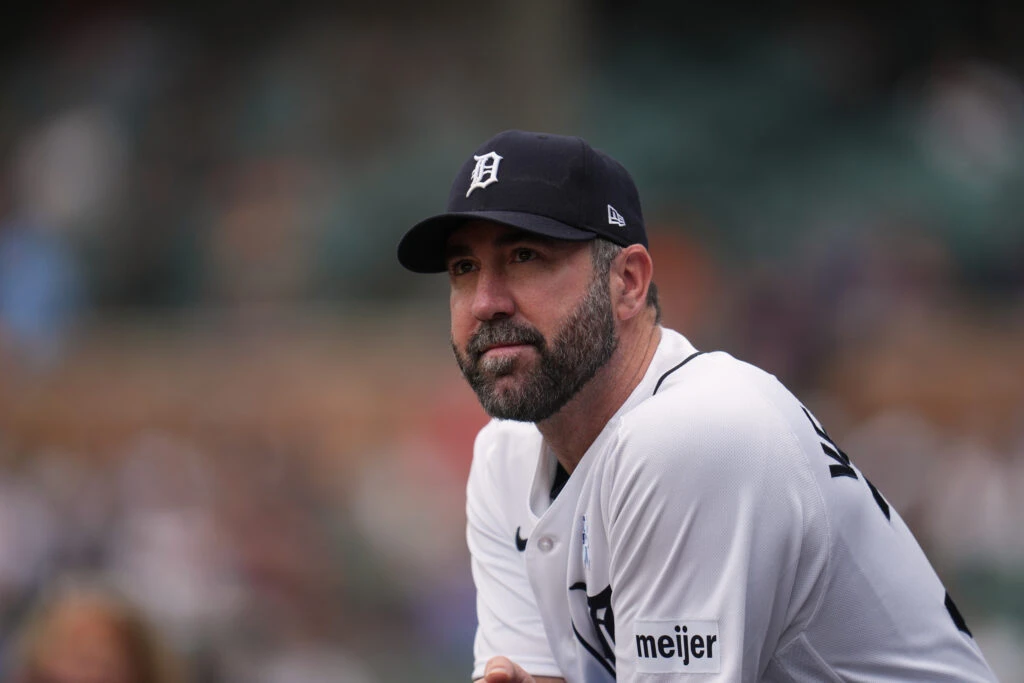
Detroit Tigers’ Justin Verlander jokes with catcher Jake Rogers, left, after a win over the Athletics in a baseball game Wednesday, July 8, 2026, in Detroit. (AP Photo/Duane Burleson)
Verlander finished with 244 career wins — a total that reflects both his sustained excellence and the structural headwinds modern aces face when chasing historical milestones. His final 2026 campaign produced just one victory across four starts and 21.3 innings, averaging roughly 80 pitches per outing. It was a diminished final chapter, but one that followed a career in which Verlander posted 21-win seasons, led the American League in ERA multiple times, and won a Cy Young Award at age 39 with a 1.75 ERA — the lowest single-season mark of his career.
With Verlander retired, attention turns to Kershaw and Scherzer — the two remaining members of the triumvirate still nominally active, though both are operating well past their peak years and unlikely to add significantly to their career totals.
Beyond the Numbers: Verlander’s Legacy Transcends Statistics
Kershaw’s 2025 season offered flashes of his former brilliance: 114.3 innings pitched and a 3.36 ERA — respectable numbers for any starter, remarkable for a left-hander managing chronic back issues into his late 30s. Scherzer’s 2026 campaign told a starkly different story, with just 36.1 innings pitched and a 10.23 ERA — numbers that signal the end is near for one of the most relentlessly competitive pitchers of his generation. Neither is likely to pitch his way back into Cy Young contention, and both careers are trending toward a close that mirrors Verlander’s: a gradual fade rather than a clean exit.
The broader question their collective decline raises is structural: has the sport moved past the era of the traditional ace entirely? The data points in that direction. Average innings per start have declined steadily over the past decade, and the number of pitchers reaching 200 innings in a season has dropped sharply across the league. The role that Verlander, Kershaw, and Scherzer occupied — the workhorse No. 1 starter who anchors a franchise rotation for 15-plus years and eats innings in October — may no longer be a viable organizational model in an era built around bullpen depth and pitcher preservation.
What separated Verlander from his peers was not just raw talent — it was the relentless competitive drive that pushed him to reinvent his approach when his fastball velocity dipped from the mid-90s into the low-90s, and to come back from Tommy John surgery at age 36 and win a Cy Young Award at 39. That combination of physical resilience and intellectual adaptability made him a model for younger pitchers across the sport and a case study in how elite competitors extend careers that most analysts had already written off.
The statistical case for Verlander’s Hall of Fame induction is airtight and likely to generate one of the stronger first-ballot vote totals in recent memory. Three Cy Young Awards (2011, 2019, 2022), one AL MVP (2011), a no-hitter, 3,300-plus career strikeouts, and 244 wins across parts of 20 major league seasons form the foundation. But the numbers only tell part of the story. Verlander was also one of the most analytically sophisticated pitching minds in the game — a starter who understood spin rate, pitch sequencing, and hitter tendencies at a level that kept him effective long after his mid-90s fastball became a memory and opposing lineups had years of data on his arsenal.
The Next Generation: Can Anyone Match the Greatness of Baseball’s Iconic Trio?
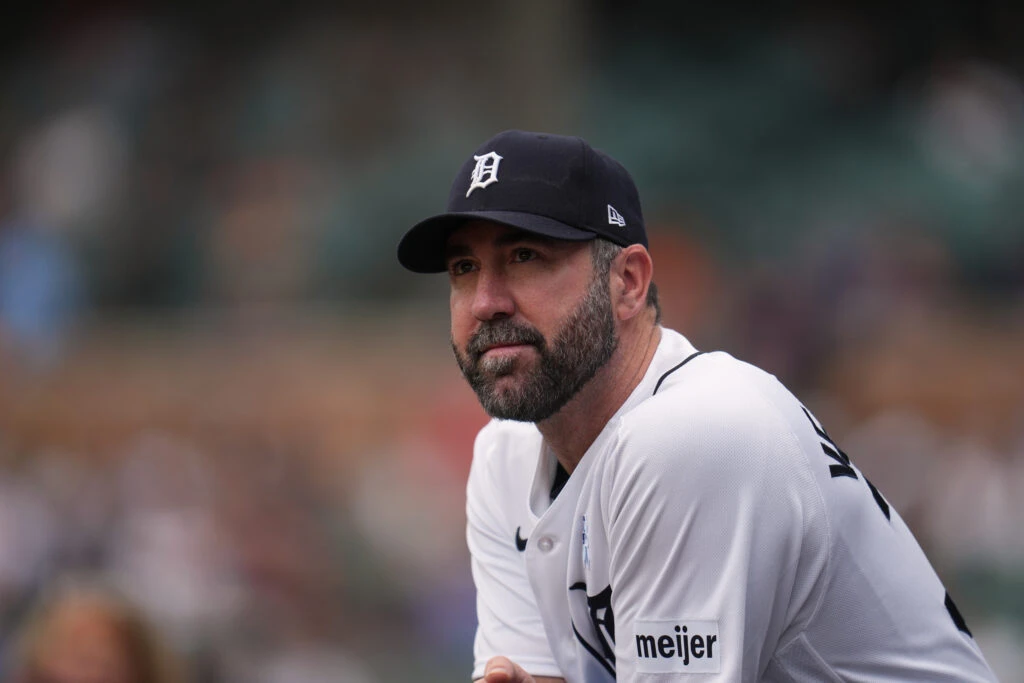
FILE — New York Mets starting pitcher Justin Verlander (35) throws during the first inning of a spring training baseball game against the Miami Marlins, Saturday, March 4, 2023, in Jupiter, Fla. Verlander left the champion Astros for the New York Mets after winning his third Cy Young Award. (AP Photo/Lynne Sladky, File)
Verlander’s influence on the game will outlast his final box score line by decades. His 2026 swan song — four starts, 21.3 innings, averaging roughly 80 pitches per outing — was a far cry from his prime, but it was also a reminder of how long elite pitchers can compete when they manage their bodies intelligently and adapt their approach to what their arm can still deliver. Younger pitchers across the sport have studied his mechanics, his between-start preparation routines, and his competitive mindset for years, and that influence does not retire when he does.
As Verlander steps away, the sport enters a genuine transitional period at the top of the rotation. The next wave of elite starters — names like Tarik Skubal, Paul Skenes, and Zack Wheeler — are talented and, in some cases, already among the best pitchers in the game. But none has yet demonstrated the decade-long sustained dominance that defined the Verlander-Kershaw-Scherzer era, and the structural conditions of the modern game make that kind of longevity harder to achieve than it has ever been.