The Las Vegas Raiders terminated head coach Pete Carroll after just one catastrophic season, finishing with a league-worst 3-14 record that sent shockwaves through the franchise.
The Las Vegas Raiders fired head coach Pete Carroll on January 5, 2026, following a single season that produced a league-worst 3-14 record — the most losses of any NFL team in 2025 and one of the most complete single-season collapses in recent franchise history.
The dismissal represents the Raiders’ fourth head coaching change in four consecutive seasons — a streak of organizational instability that has no modern parallel among franchises that once considered themselves playoff-caliber. The revolving door at head coach has not just cost the team wins; it has eroded the roster continuity, player development timelines, and locker room culture that sustained success requires.
Carroll’s tenure officially began on January 25, 2025, when, according to NFL.com, the Raiders hired him to replace Antonio Pierce, betting that his Hall of Fame-caliber résumé — built across 15 seasons in Seattle that included two Super Bowl appearances and one championship — could stabilize a franchise in freefall. The optimism surrounding the hire was genuine. Carroll had won consistently in the NFL and at USC, and his familiarity with several key roster pieces made the fit seem logical on paper.
Carroll’s opening game — a 20-13 victory over the New England Patriots on September 7, 2025 — made him the oldest head coach in NFL history at 73 years old, a milestone that generated significant national attention and briefly suggested the Raiders had found their footing. That moment now reads as the high point of an era that deteriorated rapidly. Despite inheriting a roster with identifiable young talent and the organizational mandate to rebuild, Carroll’s tenure became a case study in what happens when a coach’s competitive instincts collide with a roster that simply isn’t ready to compete.
The Quarterback Nightmare: How Geno Smith’s Turnovers Became the Team’s Fatal Flaw
The season’s lone tangible asset: Las Vegas secured the first overall pick in the 2026 NFL Draft, giving the franchise its best opportunity in years to reset the quarterback position. That pick arrives at a complicated moment — the 2026 coaching carousel is already one of the most active in recent memory, with multiple high-profile vacancies competing for the same pool of elite candidates. The Raiders will need to offer a compelling vision, not just a top draft slot, to attract the right coach.
The Las Vegas Raiders officially terminated Pete Carroll’s contract on January 5, 2026, closing the book on a one-season tenure that ended with a 3-14 record — the worst mark in the NFL in 2025. The team lost 14 of its final 16 games after that opening-week win, a collapse that was both statistically historic and organizationally damaging.
Four head coaches in four seasons is not a run of bad luck — it is a structural problem. The Raiders have now cycled through Jon Gruden, Rich Bisaccia (interim), Josh McDaniels, Antonio Pierce, and Pete Carroll since 2021, burning through coaching staffs, offensive systems, and player development cycles at a pace that makes sustainable winning nearly impossible to build.
Carroll arrived on January 25, 2025, carrying credentials that few active coaches could match. His 15-year run in Seattle produced a 137-89-1 regular-season record, two NFC Championship appearances, and Super Bowl XLVIII — a 43-8 demolition of the Denver Broncos, as recapped by NFL.com. The Raiders were betting that pedigree could paper over a roster with significant holes at multiple positions.
His debut — a 20-13 win over the New England Patriots — made Carroll the oldest head coach in NFL history at 73 years old, a record that generated genuine national attention. That milestone now serves as a footnote to one of the most thorough single-season collapses in recent memory, a 3-14 campaign that raised serious questions about whether the hire was ever the right fit for where this franchise actually stood.
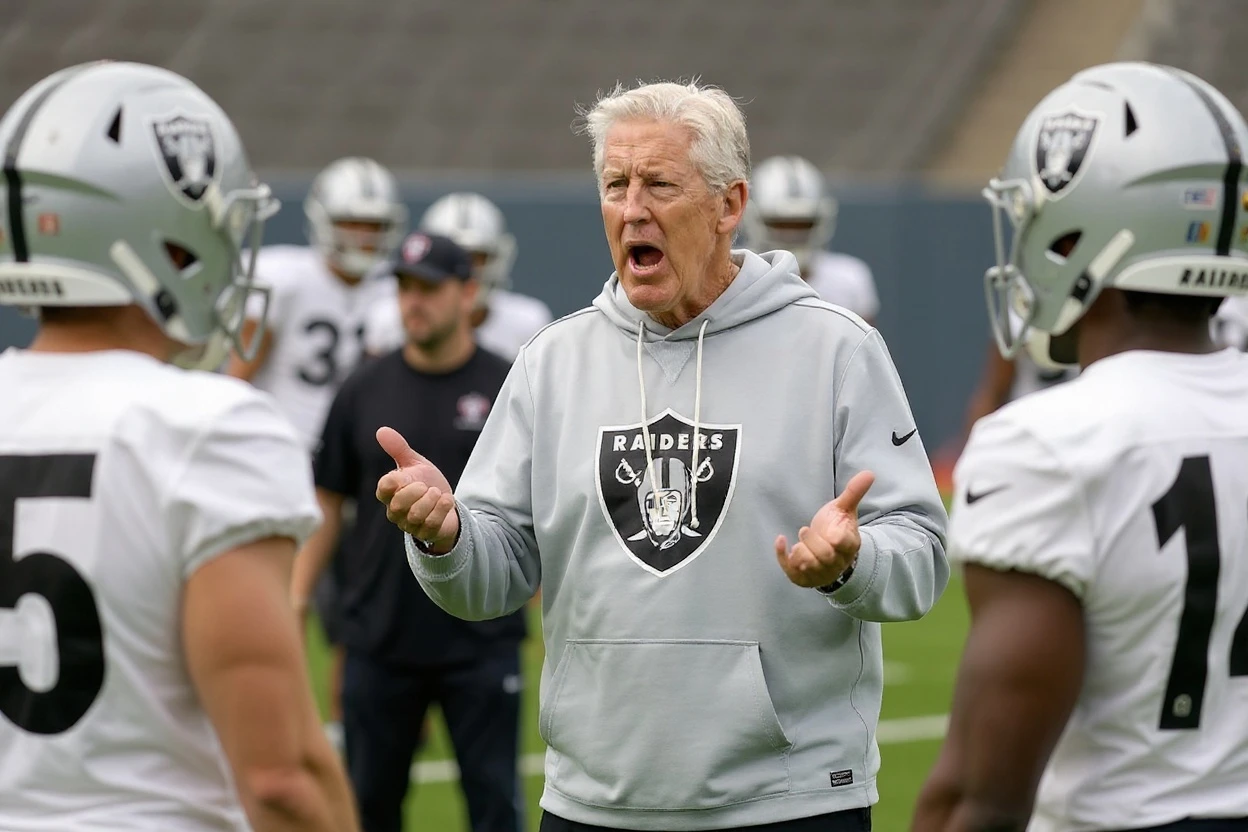
The Mid-Season Purge: Why Firing Chip Kelly Exposed Carroll’s Crumbling Foundation
The Raiders finished with the first overall pick in the 2026 NFL Draft — the one concrete asset salvaged from a season defined by offensive futility, internal dysfunction, and strategic incoherence. As the 2026 coaching search accelerates, Las Vegas enters the market carrying significant institutional baggage. Four coaching changes in four years is not a selling point; it is a warning label that every serious candidate will factor into their decision.
The Geno Smith acquisition was framed as a calculated move built on proven chemistry — a shortcut to offensive competence that the Raiders believed would accelerate Carroll’s transition into the role.
Las Vegas traded for Smith during the 2025 offseason specifically to recreate the quarterback-coach dynamic that had made their partnership productive in Seattle, where Smith posted a 30-11 record as a starter from 2022 to 2023 and earned a Pro Bowl selection. The logic was sound in theory: skip the adjustment period, import a known commodity, and compete from day one.
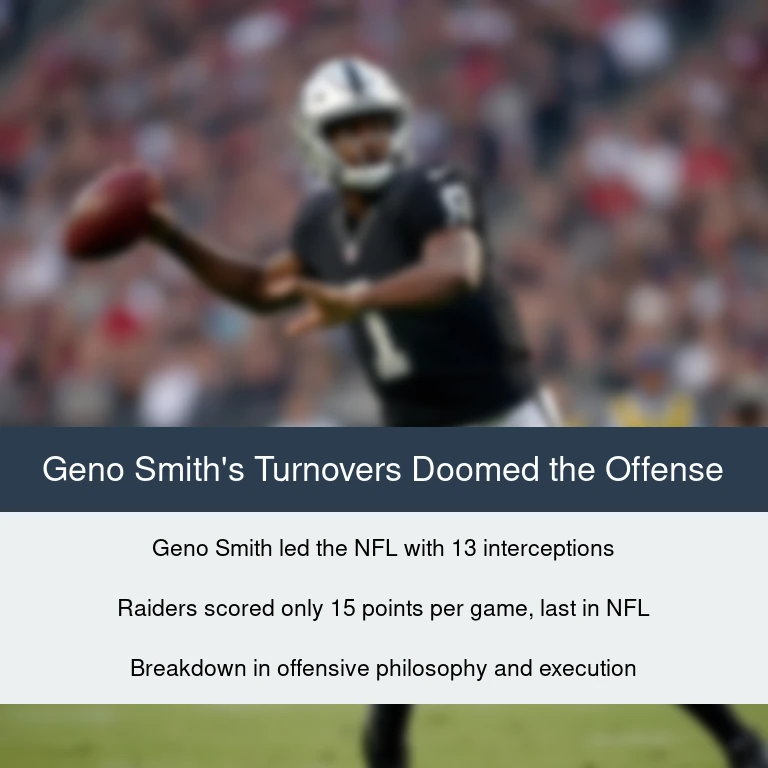
It collapsed in practice. Smith led the entire NFL with 13 interceptions in 2025, turning the ball over at a rate that made sustained offensive drives nearly impossible and put the defense in consistently difficult field position throughout the season.
The Raiders averaged just 15 points per game — tied for last in the league — a number that reflects not just poor quarterback play but a complete breakdown in offensive design, play-calling, and execution. Offensive coordinator Chip Kelly’s system, brought in to modernize and accelerate the attack, never gained traction against NFL defenses. The 15-point average wasn’t a rough stretch — it was the season-long ceiling, and it never moved.
With Smith’s contract situation now resolved and the first overall pick locked in, the Raiders hold genuine leverage to reset the quarterback position from scratch. That is a significant shift for a franchise that has not had a clear answer at the position since Derek Carr’s final seasons in Las Vegas.
The Organizational Chaos: Why the Raiders’ Revolving Door of Coaches Shows No Signs of Stopping
The 2026 draft class features several high-upside quarterback prospects, and Las Vegas will have its choice of the field — a rare opportunity for a franchise that has cycled through signal-callers almost as frequently as it has cycled through head coaches. How the organization uses that pick will define the next chapter of the rebuild.
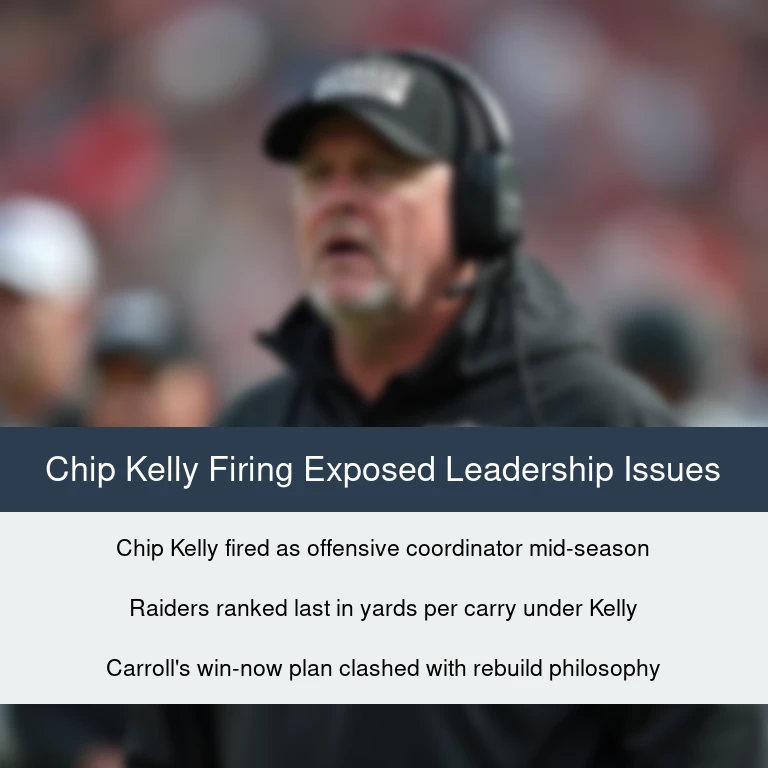
The mid-season firing of offensive coordinator Chip Kelly after just 11 games was the moment that confirmed what the standings had been signaling for weeks: this coaching staff was not functioning as a coherent unit, and no amount of in-season adjustment was going to fix it.
Kelly had been brought in to install a modern, up-tempo offensive system capable of generating explosive plays and creating mismatches in space. Instead, his tenure produced historically poor output — the Raiders ranked last in the NFL in yards per carry and averaged 15 points per game across his entire run, numbers that reflect a scheme that never found its footing against professional competition.
Firing a coordinator mid-season is an organizational admission of failure, not a corrective measure, and it exposed the deeper philosophical conflict at the heart of Carroll’s tenure. Carroll’s instinct — shaped by 15 years of competing for NFC West titles — was to win immediately. The Raiders’ roster, built for a multi-year rebuild, was not equipped to support that approach. Those two realities were never reconciled, and the team paid for it every week.
Nowhere was that tension more visible than in the handling of rookie running back Ashton Jeanty, a first-round pick according to the Raiders, selected to anchor the backfield for the next several seasons. Jeanty played a limited role throughout the year, his development subordinated to a win-now philosophy that was, by any measure, winning nothing. The cost of that misalignment will be felt in his development timeline going forward.