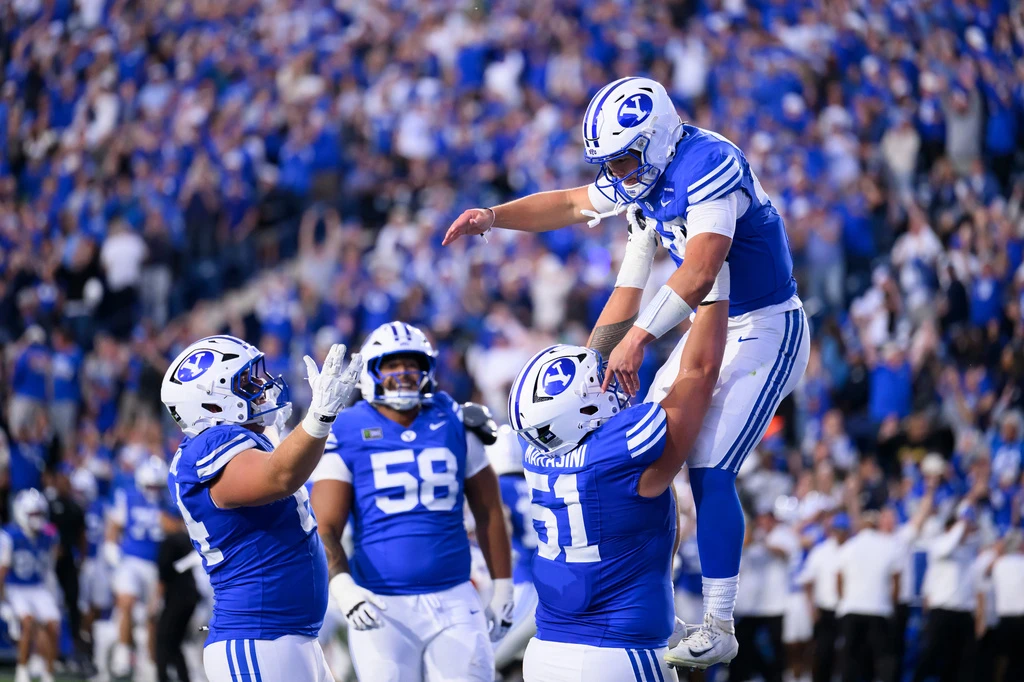
BYU’s 28-24 victory over then-No. 2 Notre Dame was not built on statistical domination. The Fighting Irish gained more yards, ran more plays and held the ball longer than the Cougars.
BYU won because it was substantially better in the situations that carried the most value.
The Cougars converted eight of 12 third downs and scored touchdowns on all four of their red-zone possessions. Notre Dame went eight of 19 on third down and scored on three of five red-zone trips, according to the official Big 12 box score.
That contrast offers the clearest explanation for BYU’s biggest win of the season. The Cougars did not control every statistical category, but they controlled the plays that determined how drives ended.
BYU Won With Efficiency, Not Volume
Notre Dame finished with 376 yards of offense, 16 more than BYU. The Irish ran 79 plays to the Cougars’ 67 and held the ball for 30 minutes and 58 seconds, nearly two minutes longer than the home team.
Those numbers normally describe the team with the upper hand. In this game, however, they reflected the difference between accumulating yards and converting them into points.
BYU averaged 5.4 yards per play, compared with Notre Dame’s 4.8. The Cougars also narrowly outrushed the Irish 121-115 despite playing without leading running back LJ Martin.
The more significant difference appeared once the teams approached the goal line. BYU produced 28 points from four red-zone possessions, an average of seven points per trip. Based on the scoring summary, Notre Dame generated 17 points from five red-zone opportunities, an average of 3.4.
That gap allowed BYU to survive Notre Dame’s advantage in total plays and yards. The Irish reached scoring range often enough to win, but the Cougars repeatedly forced them to accept field goals.
Notre Dame kicker Spencer Porath made attempts from 46, 31 and 39 yards. Those kicks kept the Irish close, but they also represented drives on which BYU prevented a potential four-point swing. Over the course of a four-point game, those defensive stands became decisive.
Long Drives Established BYU’s Approach
BYU established its offensive identity on its opening possession. The Cougars traveled 75 yards in 11 plays and consumed 5:39 before Bear Bachmeier scored on a 5-yard run.
That drive offered an early preview of what followed. BYU converted a third-and-5 when Bachmeier found Kyler Kasper for 6 yards, then continued advancing without relying on an explosive play. The Cougars reached the end zone by remaining on schedule and completing manageable conversions.
Their second touchdown drive covered another 75 yards, this time in 10 plays. It ended with one of the game’s most creative calls: Kasper took a backward pass and threw across the field to Bachmeier, who followed his blockers for a 15-yard receiving touchdown.
The play gave Bachmeier a receiving score to go with the two rushing touchdowns and passing touchdown he would ultimately record.
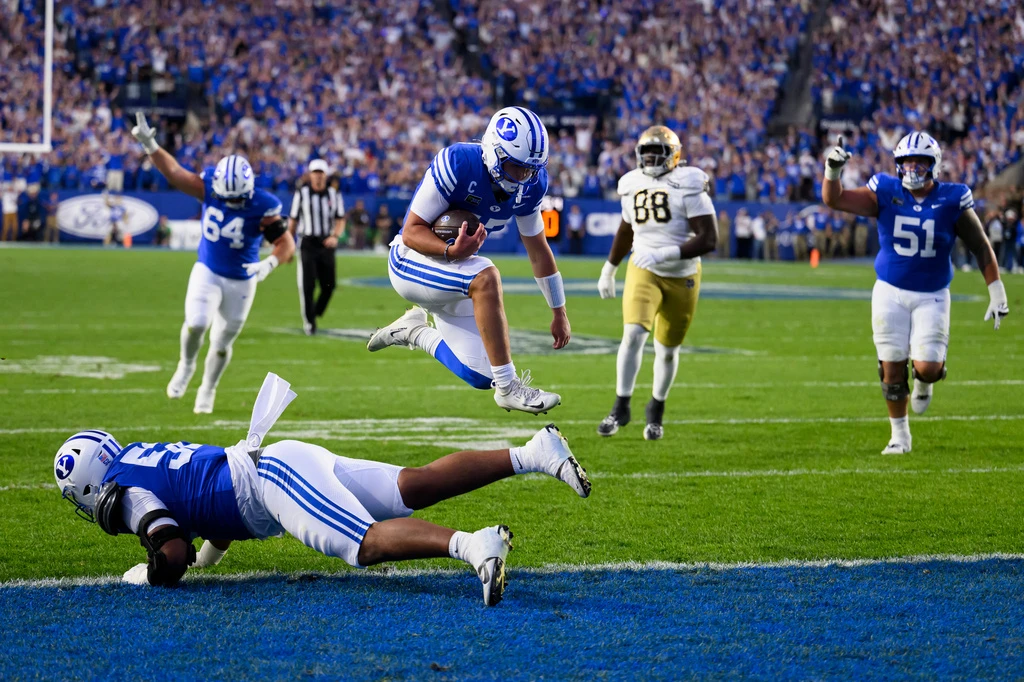
BYU’s third scoring possession followed the same method. The Cougars moved 72 yards in eight plays, with Bachmeier scoring from 1 yard to produce a 21-10 halftime lead.
The similarity among those possessions was notable. BYU’s first three touchdown drives covered 75, 75 and 72 yards. The Cougars did not benefit from short fields or defensive turnovers. They repeatedly drove the length of the field against one of the nation’s highest-rated defenses.
Bachmeier’s Versatility Changed the Math
Bachmeier accounted for all four BYU touchdowns. He completed 23 of 36 passes for 224 yards, one touchdown and one interception. He also rushed 13 times for 45 yards and two scores while catching the 15-yard touchdown pass from Kasper.
The sophomore became the first BYU quarterback since Steve Young in the 1983 Holiday Bowl to pass, run and catch a touchdown in the same game, according to BYU Athletics.
His value went beyond the four scores. Bachmeier’s rushing ability helped BYU compensate for Martin’s absence and created an additional assignment for Notre Dame’s defense in short-yardage situations.
The Cougars converted third downs through several different methods. Bachmeier completed passes to Kasper, Walker Lyons and Jojo Phillips to extend drives, but BYU also used quarterback runs and a speed option to keep the defense from committing entirely to the passing game.
That variety was particularly important because Notre Dame entered the contest with one of the country’s best defensive profiles. BYU finished with 360 yards, the most the Irish had allowed since an October 2025 game against Southern California, according to BYU Athletics.
Notre Dame had been allowing 214 yards per game and averaging 2.5 sacks. The Irish did not record a sack against BYU, and the Cougars allowed only two tackles for loss.
Those numbers point to an important part of Bachmeier’s performance that four touchdowns alone do not capture. His offensive line gave him enough time and space to operate without allowing Notre Dame’s defensive front to dictate the game.
BYU Responded After Losing the Lead
The Cougars’ composure faced its strongest test in the fourth quarter.
Notre Dame erased the 21-10 halftime deficit and moved ahead 24-21 with 9:31 remaining. Bachmeier then threw an interception on BYU’s next possession, giving the Irish the ball at their own 15-yard line with an opportunity to extend the lead.
BYU’s defense responded with a three-and-out. Cade Uluave opened the possession by tackling Nolan James Jr. for a 4-yard loss, and the Irish punted two plays later.
Cannon DeVries returned the punt 23 yards, allowing BYU to begin at its own 45 rather than deep in its territory. That field-position change set up the defining possession of the game.
The Cougars traveled 55 yards in 10 plays. They converted two third downs, including a third-and-5 completion from Bachmeier to Phillips. A 26-yard pass to Legend Glasker moved the ball to the Notre Dame 15.
BYU then leaned on Bachmeier near the goal line. He carried four consecutive times and helped move the ball to the 1, but a false-start penalty pushed the Cougars back to the 6 on third down.
The penalty forced BYU to abandon a straightforward short-yardage attempt. Bachmeier responded by finding Lyons for a 6-yard touchdown with 1:47 remaining.
That final sequence captured the larger story of the game. BYU faced third-and-goal after a damaging penalty and still finished the possession with seven points. The Cougars’ success in decisive situations was not limited to one quarter or one type of play.
The Ending Requires Important Context
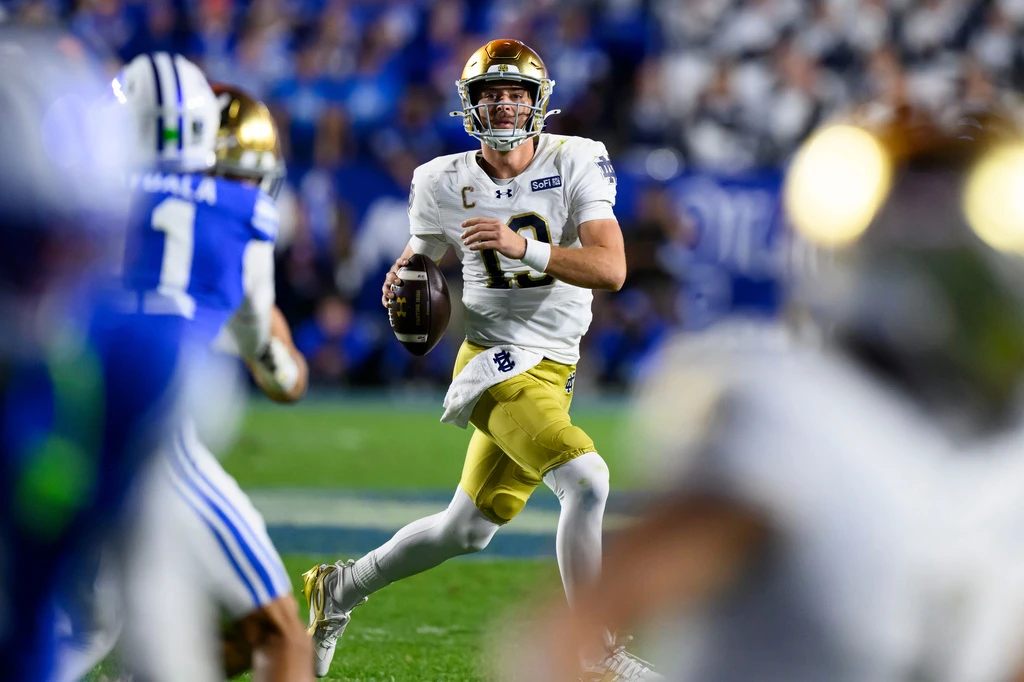
Notre Dame reached the BYU 9-yard line on its final possession, but CJ Carr’s pass into the end zone fell incomplete as the clock expired.
The Big 12 later acknowledged that time remained when the ball hit the ground. The conference said the replay officiating crew incorrectly cleared the remaining time and that Notre Dame should have received another play, as reported by The Associated Press.
The officiating error does not change the official result, but it must be included in a complete account of the finish. BYU earned its four-point lead through superior situational execution, although the Cougars did not have to defend it for the final snap that should have occurred.
That distinction keeps the analysis grounded. The victory was significant and supported by several strong aspects of BYU’s performance, but the ending was closer and more complicated than a routine final defensive stop.
Martin’s Absence Has Changed the Offense
BYU’s success without Martin also deserves attention because it illustrates both the team’s adaptability and a potential concern for the remaining schedule.
Martin rushed for 344 yards and three touchdowns on 44 carries over BYU’s first four games, averaging 7.8 yards per attempt. His production included 54 yards against Utah Tech, 98 against Arizona and 176 against Colorado State.
ESPN’s Pete Thamel reported that Martin would miss four to six weeks because of a lower-body injury suffered against TCU. That timetable makes a November return possible, but it does not establish a guaranteed return date.
Without Martin, BYU relied on Preston Rex and Bachmeier against Notre Dame. Rex led the Cougars with 66 rushing yards on 10 attempts, while Bachmeier handled 13 of the team’s 30 rushing attempts.
Bachmeier has now carried 49 times for 284 yards and six touchdowns through six games. He has also completed 100 of 152 passes for 1,257 yards, nine touchdowns and two interceptions. His official passer-efficiency rating is 152.2, according to the Big 12’s statistics.
His versatility gives BYU an answer while Martin is unavailable, but it also concentrates a growing share of the offense around one player. The challenge for the coaching staff is to preserve the schematic advantage created by Bachmeier’s legs without making the quarterback absorb an unsustainable workload.
BYU’s Record Gives the Victory More Weight
The win improved BYU to 6-0 and moved the Cougars from No. 8 to No. 2 in the AP poll. It is the program’s highest ranking since its 1984 national championship season.
BYU received 20 first-place votes and finished behind only Miami in the poll, according to The Associated Press.
The Cougars are now 29-4 since the beginning of the 2024 season, a winning percentage of .879. That ranks second in the FBS during the period, behind Indiana’s 33-3 record.
The longer view matters because it changes the meaning of the Notre Dame result. BYU did not suddenly become relevant through one home upset. The Cougars had already built one of the best records in the country over more than two seasons.
Beating Notre Dame provided the high-profile result that had been missing from that argument. It connected BYU’s sustained win total with a victory over a top-two opponent on a national stage.
UCF Will Test Whether the Formula Travels
BYU now returns to Big 12 play with a road game against UCF on Saturday in Orlando. The Knights enter the matchup at 3-3, while the Cougars are 3-0 in conference play.
The setting and opponent are different, but BYU’s underlying questions remain the same. Can the Cougars continue finishing drives at an exceptional rate? Can the defense force opponents to trade touchdowns for field goals? Can the offense distribute the rushing workload without Martin?
Head coach Kalani Sitake has emphasized preparation rather than allowing one result to define the season.
“I quoted LaVell Edwards to the team on Monday. LaVell said the will to prepare is more important than the will to win. So far in practice, I like what I’m seeing. It’s a really mature group. The guys aren’t afraid to work hard. I can do a lot of things with guys that are willing to work hard,” Sitake told ESPN.
BYU’s strongest argument for national relevance is no longer a demand for recognition. It is the combination of a 29-4 record and a repeatable ability to execute in high-value situations.
The Notre Dame game demonstrated that the Cougars do not need to dominate every category to beat a leading opponent. They need to protect Bachmeier, extend drives and turn scoring opportunities into touchdowns.
Against the Irish, that formula was enough to overcome a yardage deficit, an injury to their leading running back and a fourth-quarter deficit. Whether it remains enough through the Big 12 schedule will determine how long BYU stays near the top of the national rankings.