
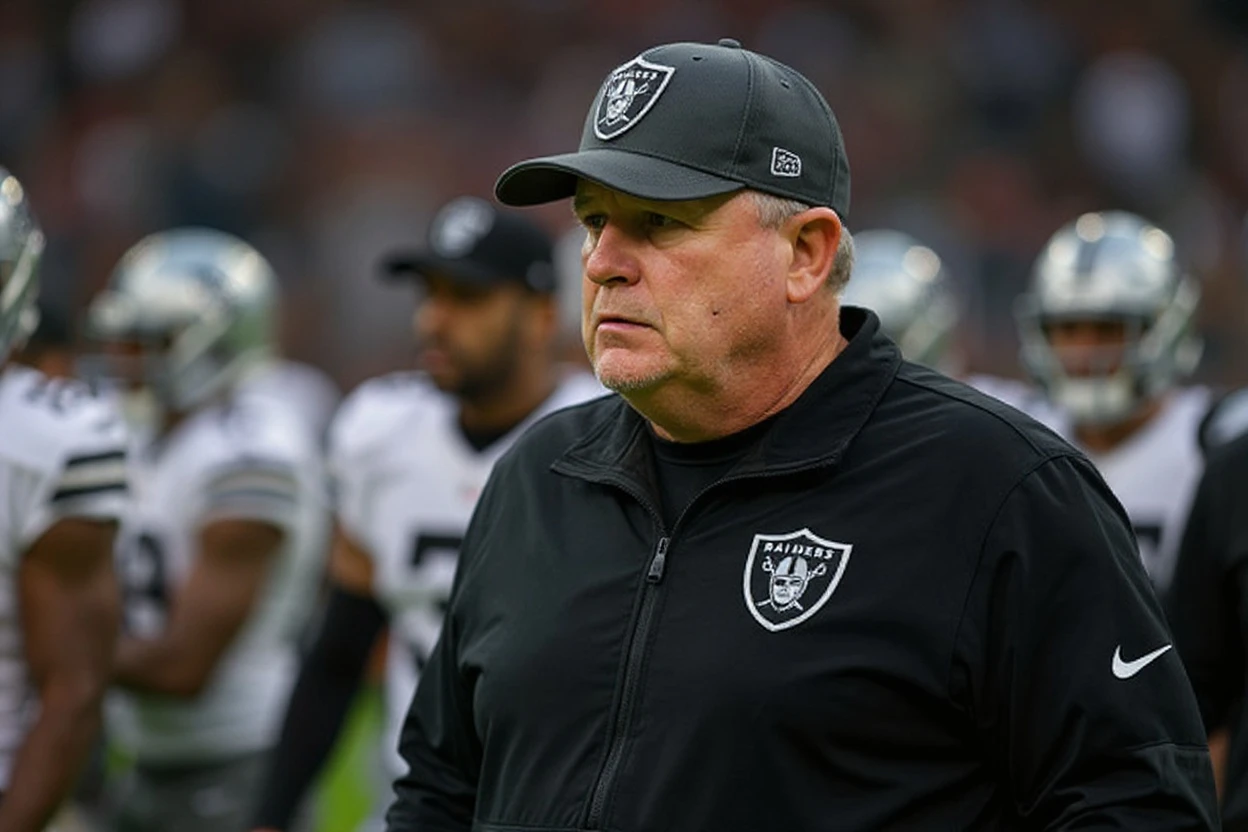
The Las Vegas Raiders’ decision to fire offensive coordinator Chip Kelly after just 11 games wasn’t simply a personnel move — it was an admission that the franchise’s offensive infrastructure had collapsed under the weight of competing philosophies.
The Las Vegas Raiders’ decision to fire offensive coordinator Chip Kelly after just 11 games was more than a mid-season personnel adjustment — it was a public acknowledgment that the franchise’s offensive infrastructure had buckled under the weight of two irreconcilable football philosophies, and that no one in the building had the authority or willingness to resolve the conflict before it became a crisis.

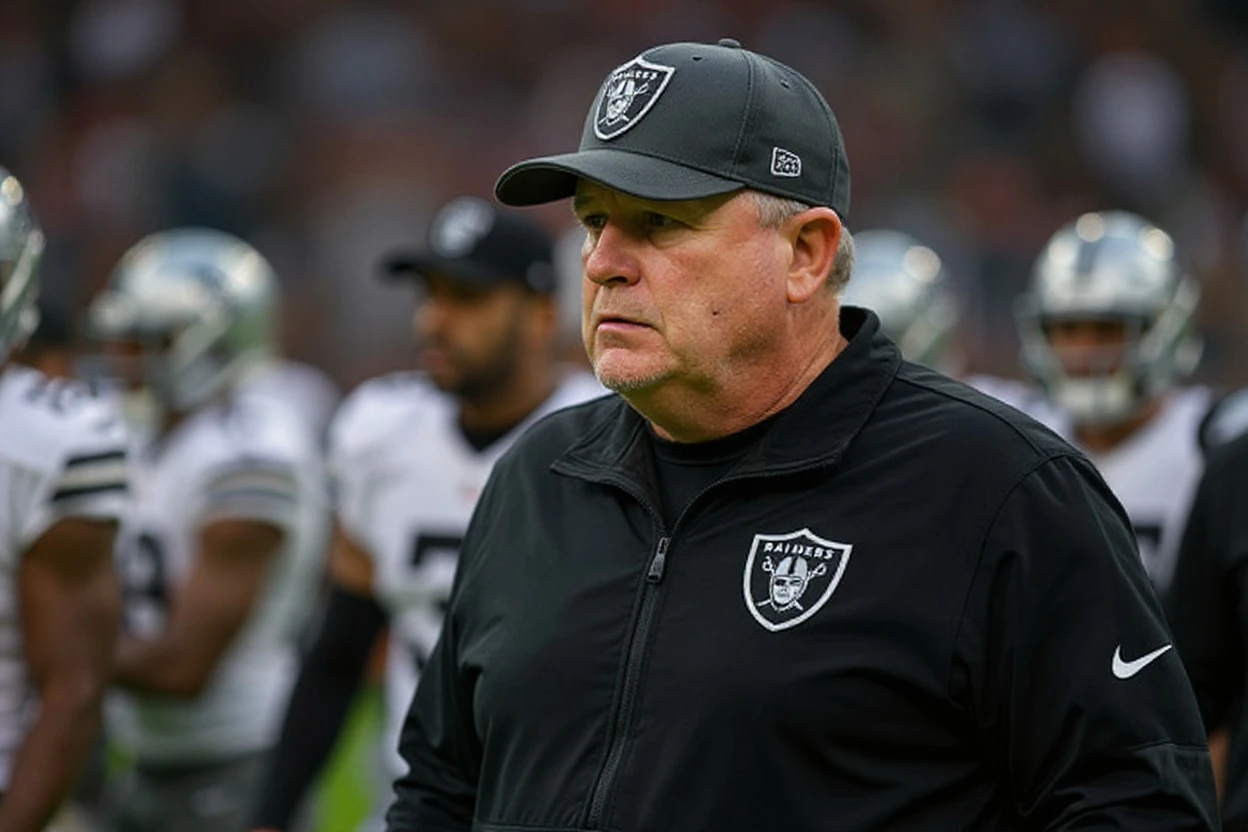
Kelly’s 11-game tenure produced offensive numbers that ranked among the worst in the modern NFL era, exposing a fundamental breakdown in organizational cohesion under head coach Pete Carroll.
The problems ran far deeper than one coordinator’s failed adjustment to the pro game — they reflected a front office that hired an innovative offensive mind and then systematically stripped him of the tools to innovate.
The Crumbling Offense: Inside the Raiders’ Disastrous Chip Kelly Experiment
The Raiders’ offense under Kelly was historically bad by any modern NFL standard. Las Vegas averaged just 15 points per game through the first 11 weeks, tying for last in the league in scoring output.
Their rushing attack ranked dead last in yards per carry for the second consecutive season — a damning indictment of an offensive line that has failed to generate consistent movement at the point of attack regardless of scheme or personnel grouping.
Kelly arrived in Las Vegas with legitimate credentials that made the hire defensible on paper. He had just served as offensive coordinator for Ohio State’s College Football Playoff national championship team in January 2025, helping orchestrate one of the most productive offenses in college football, a national title run News 3 Las Vegas noted preceded his Raiders hire.
His shotgun-heavy, tempo-driven system had proven effective at the highest level of the college game. The problem was that none of those principles were ever allowed to take root in Las Vegas.
Clashing Philosophies: Carroll’s Old-School Approach vs. Kelly’s Innovative Mindset
According to NFL Network reporting, the structural dysfunction was apparent from the start: Carroll’s fingerprints were all over the play-calling process, consistently steering the offense toward the under-center, zone-run scheme he had favored during his final season with the Seattle Seahawks in 2023, the year NFL.com reported ended his 14-season Seahawks tenure.
Kelly’s tempo concepts and spread-influenced formations were constrained before they could be properly evaluated, leaving the Raiders with a hybrid system that committed fully to neither approach.
The philosophical collision between Carroll’s old-school, run-first identity and Kelly’s up-tempo, spread-influenced attack proved unworkable almost from the opening week. Rather than blending into a coherent system, the two approaches created schematic confusion that opposing defenses were quick to exploit.
Opposing defensive coordinators reportedly used Seattle’s 2023 game film as their primary scouting reference when preparing for Las Vegas — a stunning indictment of how predictable the Raiders’ offense had become.
By anchoring to Carroll’s preferred concepts, the Raiders surrendered the schematic unpredictability that makes any offense difficult to defend week to week.
Beyond the strategic mismatch, reports emerged of Kelly calling plays outside the established game plan during live games — an extraordinary breakdown of process in a league where weekly preparation is exhaustive and every play call carries strategic weight.
For a coordinator fresh off a national championship run, the adjustment to Carroll’s top-down command structure appeared to generate real and sustained friction that never resolved itself.
Geno Under Fire: Smith’s Turnover Woes Compound Offensive Struggles
Kelly, by multiple accounts, grew increasingly frustrated by the degree to which Carroll dictated offensive direction, creating a working environment where coherent, consistent play-calling was structurally impossible. When a coordinator cannot trust that his game plan will be executed as designed, the entire preparation process breaks down — and that breakdown showed up in the results every Sunday.
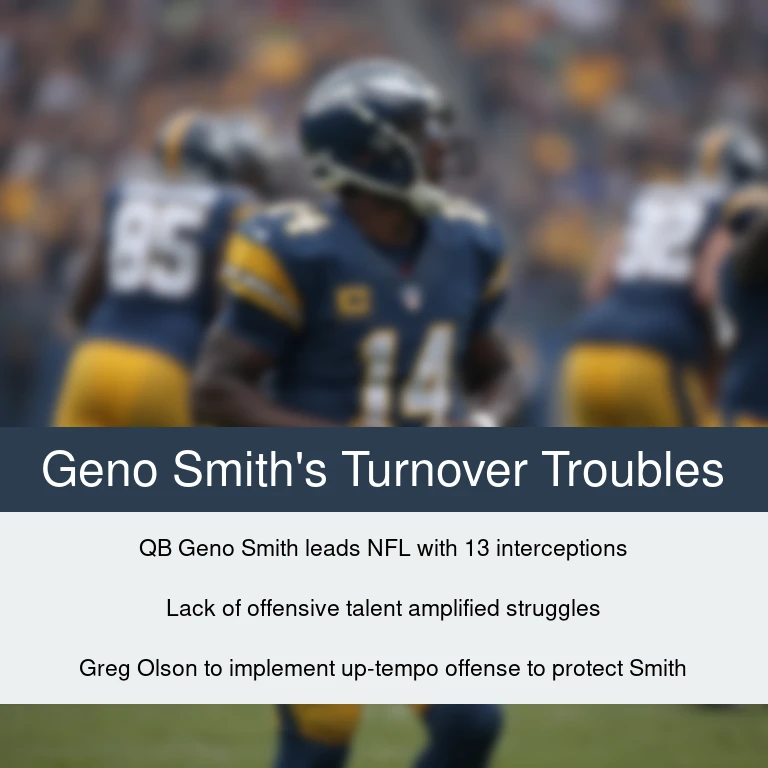
Quarterback Geno Smith’s performance compounded every structural problem the Raiders faced, adding a turnover crisis on top of an already dysfunctional offensive system.
Smith led the entire NFL with 13 interceptions through the first 11 weeks of the season — a pace that would project to roughly 19 interceptions over a full 17-game schedule. That turnover rate erased offensive momentum before it could build, consistently flipping field position and putting the Raiders’ defense in impossible situations. No coordinator, regardless of system, can sustain a functional offense when the quarterback is generating turnovers at that frequency.
Interim offensive coordinator Greg Olson is expected to introduce more up-tempo elements designed to reduce pressure on Smith and limit the negative plays that have defined Las Vegas’s offensive identity in 2025.
But the underlying schematic DNA — Carroll’s zone-run preferences and his insistence on controlling offensive direction — is unlikely to change dramatically with a coordinator who has a long-standing relationship with the head coach.
Rebuilding Pains: Raiders’ Win-Now Mentality Clashes with Youth Development
That reality raises serious questions about whether any coordinator can succeed in Las Vegas without full, clearly defined autonomy over the offensive system.
If Carroll’s involvement in play-calling and scheme selection remains unchanged, Olson’s interim tenure may produce marginally better results without addressing the structural problem that made Kelly’s situation untenable.
The dysfunction extends beyond the offensive side of the ball. Carroll’s win-now mentality — understandable given that he is 74 years old and operating with a compressed competitive window — has created direct and visible tension with what should be a deliberate, long-term organizational rebuild.
The Raiders are not a roster built to contend in 2025, and the pressure to produce short-term results has distorted personnel decisions at every level.
Chaos in the Playcalling: Kelly’s Rogue Calls Defy Game Plans
First-round running back Ashton Jeanty, whom the Raiders selected sixth overall in the 2025 NFL Draft and the Raiders’ marquee 2025 draft investment and one of the most decorated college backs in recent memory, has accounted for just 36 percent of rookie offensive and defensive snaps combined through the first 11 weeks.
Limiting a top-ten pick’s development in order to protect short-term results is a high-risk tradeoff — one that could set the franchise back years regardless of how the current season resolves. Jeanty’s long-term value to the organization depends on reps, and he is not getting enough of them.
The most damaging detail to emerge from Kelly’s brief tenure was the reported pattern of off-script play-calling — instances where Kelly deviated from the agreed game plan during live game action, apparently in an attempt to implement concepts that Carroll had sidelined during the week of preparation.
In the NFL, where weekly preparation is exhaustive, film study is obsessive, and every play call carries strategic and situational weight, that kind of in-game freelancing is almost unheard of at the coordinator level. It signals a working relationship that had deteriorated to the point where the coordinator no longer trusted the system he was being asked to run.
Kelly’s staff, which included offensive line coach Brennan Carroll — Pete Carroll’s son — lacked the independence or organizational leverage to push back effectively against the head coach’s preferences. The presence of a family member in a key staff role further complicated any attempt to establish a clear chain of offensive authority separate from Carroll’s influence.

Internet Reactions to the Raiders’ Offensive Turmoil
The result was a coaching structure that tilted almost entirely toward Carroll’s preferences, leaving Kelly with the title of offensive coordinator but little of the actual decision-making authority the role demands. In practice, the Raiders ran a Carroll offense with a Kelly nameplate on the door — and the results reflected that contradiction.
The Chip Kelly experiment in Las Vegas failed not because Kelly lacks football intelligence — his track record at Oregon, UCLA, and Ohio State demonstrates otherwise — but because the conditions for success were never established. Hiring an innovative offensive mind and then systematically overriding his system is a contradiction that no amount of talent or preparation can overcome. The Raiders created a role that was coordinator in title only.
Las Vegas now faces a mid-season reset with Olson at the controls, a quarterback leading the league in turnovers, and a roster that has underutilized its most important young players at a critical stage of their development. Until Carroll and the front office resolve the fundamental question of what this offense is supposed to be — and who actually has the authority to build and execute it — the results are unlikely to improve in any meaningful way, regardless of who holds the coordinator title.
The fallout from Kelly’s dismissal has generated significant discussion among NFL analysts and fans, with many pointing to the Carroll-Kelly dynamic as a textbook case of organizational misalignment at the coaching staff level. The core criticism is not that Kelly was the wrong hire — it is that the Raiders never gave him a real opportunity to implement the system they hired him to run. That distinction matters, because it shifts accountability away from Kelly and toward the front office and head coach who structured the arrangement.