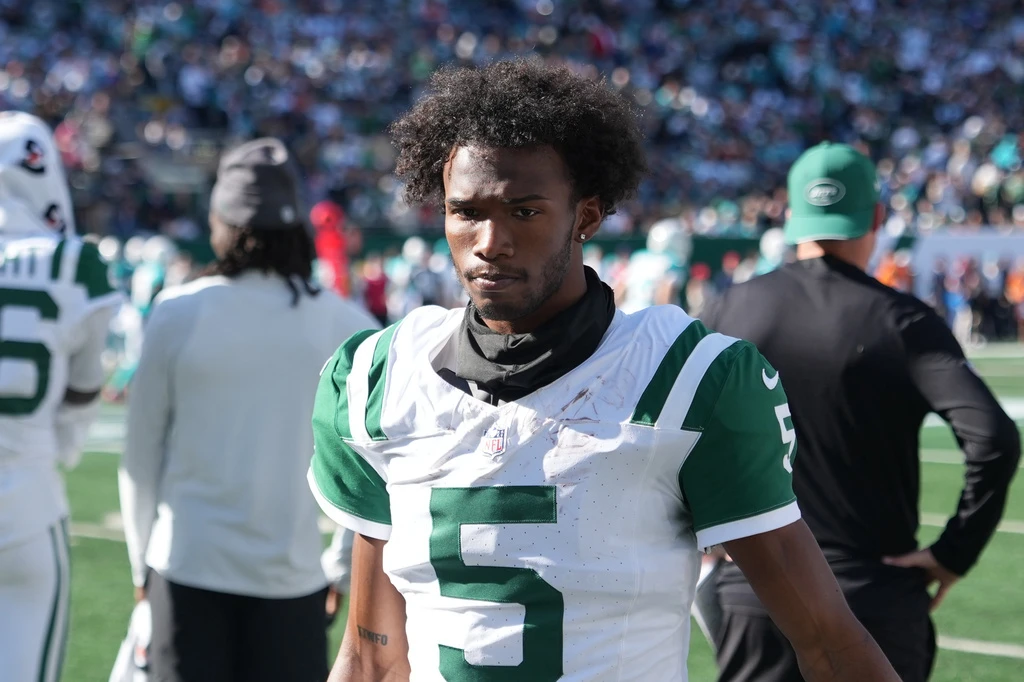
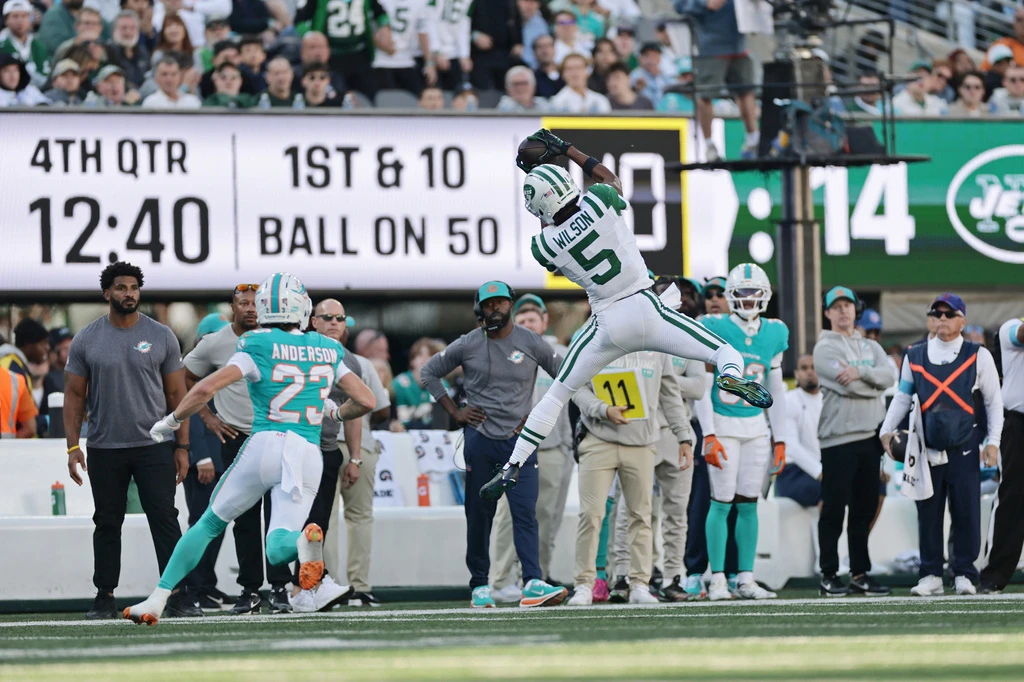
Garrett Wilson’s animated sideline conversation during the New York Jets’ 28-25 loss to the Miami Dolphins generated another round of trade speculation. It did not, however, establish that Wilson wants to leave or that the Jets are preparing to move him.
Wilson said the exchange reflected frustration with the offense and a desire to be more aggressive, not a dispute with quarterback Geno Smith.
Jets coach Aaron Glenn subsequently called the episode “overblown” and said the participants were trying to get the offense moving. Wilson caught two passes for 26 yards on three targets in the loss.
That distinction matters as the NFL’s Nov. 10 trade deadline approaches. The Jets are 2-5, but Wilson is not a typical deadline candidate.
He is 26, under contract through 2030 and one of the franchise’s most productive players. An NFL.com report published before the Miami game said the Jets had no intention of trading him, while Wilson had previously expressed a desire to win in New York.
There is also no confirmed report that the Kansas City Chiefs, San Francisco 49ers or Las Vegas Raiders have opened trade talks with the Jets. They are best viewed as hypothetical fits, not known suitors.
Any team that calls would have to answer two questions: Does Wilson improve its competitive timeline enough to justify a major offer, and would New York receive enough value to abandon a player it has treated as an offensive cornerstone?
Why Wilson would command a premium
Wilson’s résumé explains the interest. The Jets selected him 10th overall in 2022, and he won the Associated Press NFL Offensive Rookie of the Year award.
He then became one of five players in league history to record at least 80 receptions and 1,000 receiving yards in each of his first three seasons, according to the NFL.
His best full season came in 2024, when he set career highs with 101 receptions, 1,104 yards and seven touchdowns. Through seven games in 2026, NFL statistics credit him with 37 catches for 444 yards and three touchdowns.
Wilson’s contract provides long-term control, but it should not be described as inexpensive or especially team-friendly. His four-year, $130 million extension reportedly included $90 million guaranteed and carries an average annual value of $32.5 million.
A buyer would therefore be acquiring both a proven lead receiver and a substantial financial commitment. The extension keeps him signed through 2030.
New York has shown that a recent extension does not make a player untouchable. At the 2025 deadline, the Jets traded Sauce Gardner to Indianapolis for Adonai Mitchell and first-round picks in 2026 and 2027.
They also sent Quinnen Williams to Dallas for Mazi Smith, a 2026 second-round pick and a 2027 first-rounder.
Those deals demonstrate a willingness to exchange established talent for significant draft capital. They do not prove that Wilson is available. If anything, the returns New York received suggest that another club would need to make an aggressive offer.
1. San Francisco 49ers: The clearest win-now fit
Of the three possibilities, San Francisco has the strongest immediate football argument.
The 49ers entered their Week 8 bye at 6-1 after losing 29-20 to Atlanta. Their receiving depth was tested in that game because Mike Evans was unavailable with rib and Achilles issues, while Deebo Samuel Sr. remained out with a hamstring injury.
San Francisco relied heavily on Jordan Watkins, Jacob Cowing and Brandin Cooks, with Christian Kirk returning to the lineup.
Wilson would give Brock Purdy another receiver capable of winning a high target volume while complementing Samuel, Evans, George Kittle and Christian McCaffrey when the group is healthy. His age and contract also make him more than an injury replacement.
The complication is cost. San Francisco would be trading premium draft assets and assuming a major contract for a position that could become crowded once its injured receivers return.
The 49ers would need confidence that Wilson materially raises their championship ceiling, rather than merely giving them expensive depth.
His long-term value could still make that calculation worthwhile. San Francisco has the best record of the proposed destinations and the most obvious reason to prioritize the present season. If the Jets unexpectedly invited offers, the 49ers would be a logical team to investigate the price.
2. Kansas City Chiefs: A compelling need, but a difficult deal
Kansas City’s 20-3 Week 7 loss to Seattle exposed the risk of an injury-depleted receiving group. Rashee Rice was ruled out with hamstring and knee injuries, while the Chiefs had placed Tyquan Thornton on injured reserve earlier in October. Kansas City’s wide receivers combined for six receptions and 39 yards against the Seahawks.
Wilson would address both a short-term shortage and a longer-term roster question. He could provide Patrick Mahomes with a proven outside target and reduce the offense’s dependence on Travis Kelce, who cannot remain its central receiving option indefinitely.
The Chiefs were still 5-1 after the Seattle loss, so one poor performance does not establish an offensive crisis. Rice’s eventual return could also reduce the urgency to spend premium picks and absorb Wilson’s contract.
There would be additional negotiating friction. The Jets and Chiefs are AFC teams, and they are scheduled to play on Nov. 8, two days before the trade deadline.
Although that does not prevent a deal, New York would have to be comfortable strengthening a conference opponent it will have just faced.
Kansas City makes sense as a roster fit. It is less clear that the Chiefs could meet a likely asking price while preserving the draft and salary-cap flexibility needed to sustain the rest of their roster.
3. Las Vegas Raiders: A long-term move rather than a playoff push
Las Vegas presents a different case. The Raiders started 3-0 but reached Week 8 at 3-4 after four consecutive losses. That trajectory makes them an unlikely buyer if the purpose is simply to improve their 2026 playoff chances.
Wilson could nevertheless fit a broader development plan. The Raiders selected Fernando Mendoza first overall in the 2026 NFL Draft and opened the season with veteran Kirk Cousins as their starter. When Mendoza eventually takes over, Las Vegas will want a dependable group around him.
The Raiders already have tight end Brock Bowers and running back Ashton Jeanty, but their current depth chart lists Jalen Nailor and Tre Tucker as the starting wide receivers. Wilson would immediately become the passing game’s most accomplished receiver and could grow with Mendoza for several seasons.
The question is whether a rebuilding team should surrender valuable draft capital while taking on a contract of Wilson’s size. Las Vegas needs help at receiver, but it also needs inexpensive young talent across the roster.
A trade would make more sense if the Jets accepted a moderate return, which appears unlikely given Wilson’s production, age and contract control.
The Raiders therefore rank behind San Francisco and Kansas City as a deadline destination. Their interest would have to be based on a multiyear roster plan, not a reaction to the current standings.
A trade remains possible, but retention is the stronger baseline
The Jets’ 2025 deadline activity means New York cannot dismiss trade speculation merely by pointing to Wilson’s extension. Gardner was moved only months after signing his own long-term deal.
Still, the available evidence does not support treating Wilson’s departure as likely. The sideline conversation was explained by Wilson, Smith and Glenn as competitive frustration rather than a personal rupture. Wilson has not publicly requested a trade, and reporting before the Miami loss indicated that the Jets did not intend to move him.
San Francisco offers the strongest immediate fit, Kansas City has the most conspicuous short-term need, and Las Vegas provides a plausible long-term pairing with Mendoza. For any of them, however, the central issue is not whether Wilson would improve the roster.
It is whether the improvement would justify the substantial compensation and financial commitment required to persuade the Jets to change course.