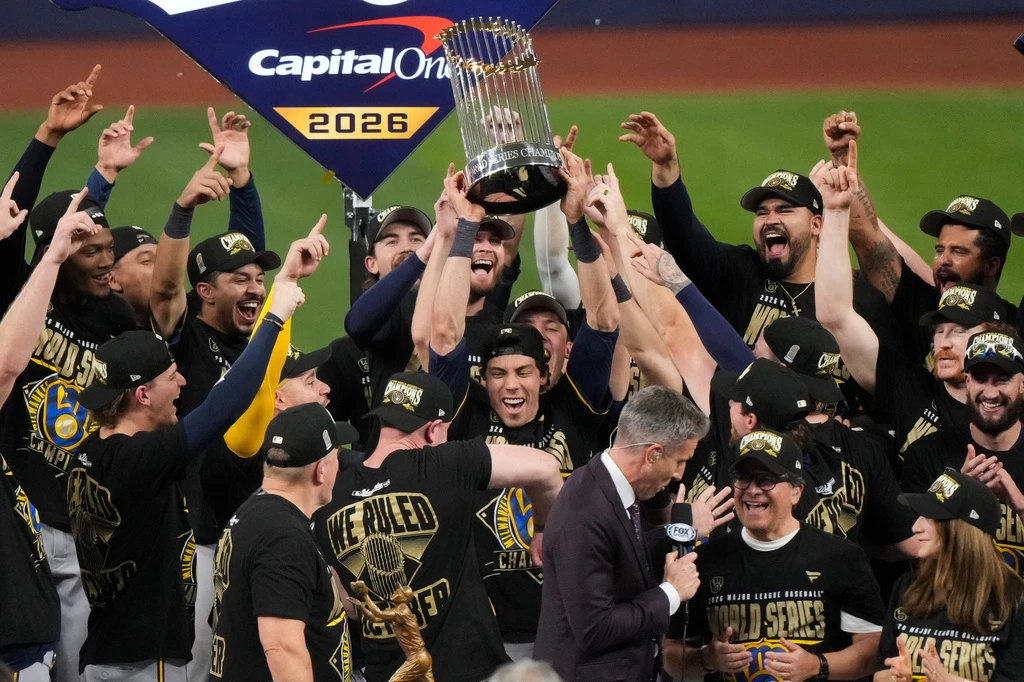
The Milwaukee Brewers captured the first World Series championship in franchise history on Wednesday, Oct. 28, defeating the Tampa Bay Rays 4-1 in Game 5 at Tropicana Field.
Milwaukee finished the postseason with an 11-2 record after winning a franchise-best 103 games during the regular season. The championship capped a year in which the Brewers combined elite pitching, productive young players and situational hitting to outperform clubs with considerably larger payrolls.
The title arrived in the franchise’s 58th season. The organization began as the Seattle Pilots in 1969 and relocated to Milwaukee the following year. Its only previous World Series appearance came in 1982, when the Brewers lost Game 7 to the St. Louis Cardinals.
For Milwaukee as a city, the victory also delivered its first Major League Baseball championship since the Milwaukee Braves defeated the New York Yankees in the 1957 World Series.
Misiorowski Controls the Clincher
Jacob Misiorowski gave Milwaukee the start it needed in Game 5, holding Tampa Bay scoreless for 5 2/3 innings. The right-hander allowed two hits, one walk and one hit batter while throwing 58 of his 86 pitches for strikes.
A right calf cramp forced Misiorowski out in the sixth inning, but Milwaukee’s bullpen protected the lead. JoJo Romero and Abner Uribe helped bridge the game to Trevor Megill, who worked the final two innings. Tampa Bay’s only run came on Chandler Simpson’s two-out double in the ninth.
Misiorowski finished the World Series 2-0 with a 0.84 ERA. His performance in the clincher was more about control than strikeouts: He recorded only two, matching his career low, but kept the Rays from producing a sustained rally. According to MLB’s account of his Game 5 start, he averaged 101.1 mph with his fastball.
Milwaukee’s lineup supplied the necessary support without relying on a home run.
Rookie shortstop Cooper Pratt opened the scoring with an RBI single against Drew Rasmussen in the second inning. Pratt singled again in the fifth and scored on David Hamilton’s hit. William Contreras added an RBI double in the sixth before Pratt’s sacrifice fly extended the lead to 4-0.
Pratt finished Game 5 with two hits and two RBIs. His fifth-inning single was his sixth consecutive hit, establishing a World Series rookie record. The distinction is important: He did not collect six hits in only six total Series at-bats, as the original draft stated.
Contreras Earns World Series MVP
Contreras was named World Series MVP after influencing the series on offense, defense and pitch management.
The Milwaukee catcher went 8-for-21, producing a .381 batting average, an .864 OPS and four RBIs. His run-scoring double in Game 5 gave the Brewers additional separation at a point when the Rays were still within reach.
Contreras was just as important behind the plate. He threw out four of Tampa Bay’s nine attempted base stealers, limiting a running game that had entered the World Series with 11 successful steals in 11 postseason attempts.
He also helped Milwaukee’s pitchers finish the Series with a 1.91 ERA while holding Tampa Bay batters to a .182 average. In the first MLB season using the Automatic Ball-Strike Challenge System, Contreras successfully overturned 10 of his 13 World Series challenges. MLB’s MVP announcement credited his work in each of those areas.
Contreras became the first Brewers player to win the award and the eighth catcher to be selected as a World Series MVP or co-MVP.
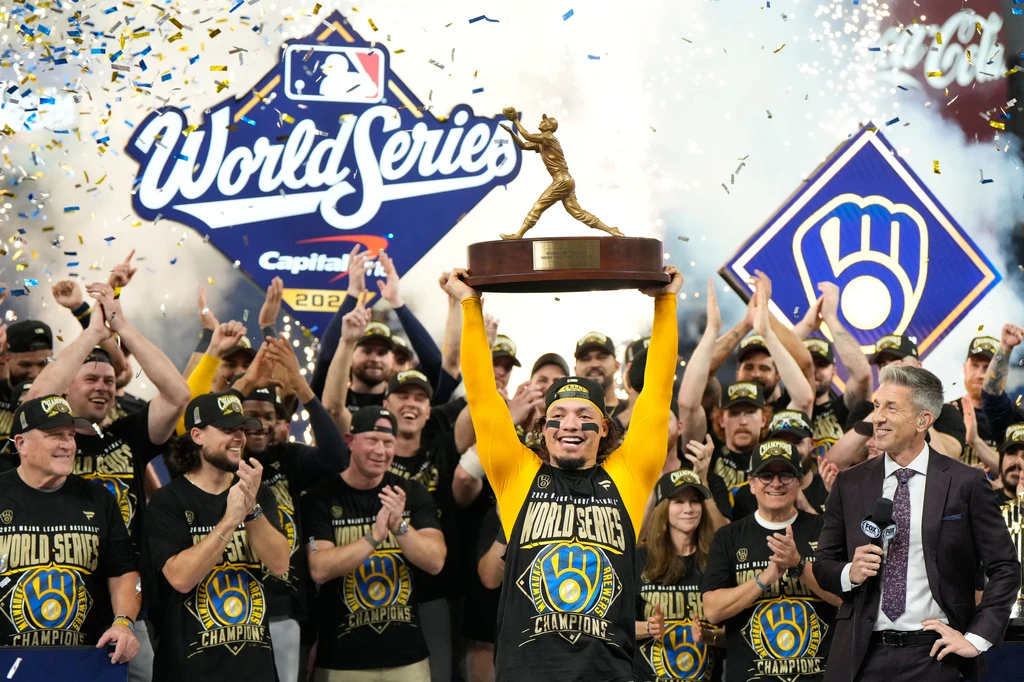
Young Hitters and a Record-Setting Bullpen
Jackson Chourio added another historic performance to Milwaukee’s championship run.
The 22-year-old outfielder collected 10 hits during the first four games, tying Babe Ruth’s 1928 record for the most hits over the opening four games of a World Series. Chourio added another hit in Game 5, giving him a record 11 hits in a five-game World Series.
Pratt and Chourio offered evidence of Milwaukee’s ability to develop young contributors rather than depending exclusively on expensive veteran acquisitions. Pratt made his major league debut in June, while Chourio was already playing a central role in the lineup at 22.
Reliever Aaron Ashby supplied another postseason record. His 2 1/3 scoreless innings in Game 4 extended his streak to 18 innings, surpassing Andrew Miller’s 16-inning run in 2016 for the longest scoreless streak by a reliever within a single postseason. The record’s precise scope matters: It applies to consecutive scoreless innings by a relief pitcher in one postseason, not to all postseason pitchers or career appearances.
Ashby’s run reflected the broader strength of Milwaukee’s pitching staff. Even after Tampa Bay forced Game 5 with a 12-inning victory the previous night, the Brewers had enough rested pitching to limit the Rays to four hits in the clincher.
An 11-2 Path Through October
Milwaukee’s championship followed a remarkably efficient postseason.
The Brewers defeated the San Diego Padres three games to one in the National League Division Series. They then swept the two-time defending champion Los Angeles Dodgers in four games before beating Tampa Bay four games to one in the World Series. Those results produced the team’s 11-2 playoff record.
The Brewers also won seven postseason games in which they trailed, showing that their October success was not built solely on early leads. MLB’s official postseason recap confirms the results from all three rounds.
The playoff run followed Milwaukee’s first 100-win regular season. The Brewers finished 103-59, the best record in the majors, and won the National League Central for a fourth consecutive year.
Their regular-season success was notable in part because of the resources involved. The Brewers ranked 19th in payroll as of Aug. 31, according to figures cited by the Associated Press, while the Rays ranked 25th. It was the first World Series since 1991 to match two teams from the lower half of MLB payrolls.
Payroll rank alone does not explain performance, and rankings can change depending on the date and accounting method. Milwaukee’s season nevertheless demonstrated how player development, trades and roster depth can narrow a financial disadvantage.
An MLB analysis of the 2026 playoff rosters calculated that Milwaukee received 31.4 wins above replacement from homegrown players, one of the highest totals among postseason teams.
That production complemented the roster assembled under president of baseball operations Matt Arnold and managed by Pat Murphy. Rather than asking one superstar to carry the team, Milwaukee received meaningful October contributions from its rotation, bullpen, catcher and young position players.
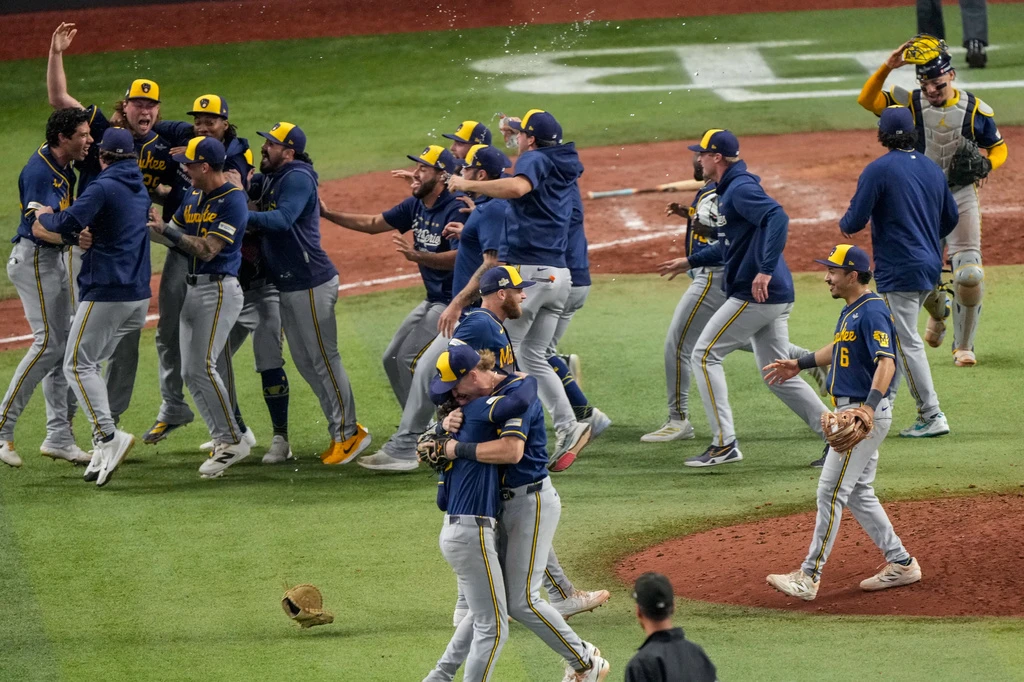
A Championship Built Without the Long Ball
The Brewers’ offensive approach gave the championship a distinctive statistical identity.
Milwaukee scored an MLB-low 32.1% of its regular-season runs on home runs, according to Elias Sports Bureau figures reported by the Associated Press. The Brewers and Rays combined for only four homers in the five-game World Series.
Game 5 illustrated how Milwaukee succeeded without waiting for a decisive home run. The Brewers scored through singles, aggressive advancement, an RBI double and a sacrifice fly. Their pitching staff then made those runs stand.
The championship does not prove that payroll disparities are unimportant or that Milwaukee’s model can be reproduced easily. It does show that the Brewers converted development, depth and run prevention into the best record in baseball and one of the most efficient postseason runs in recent history.
After 58 seasons, the franchise finally has a World Series title to show for it.