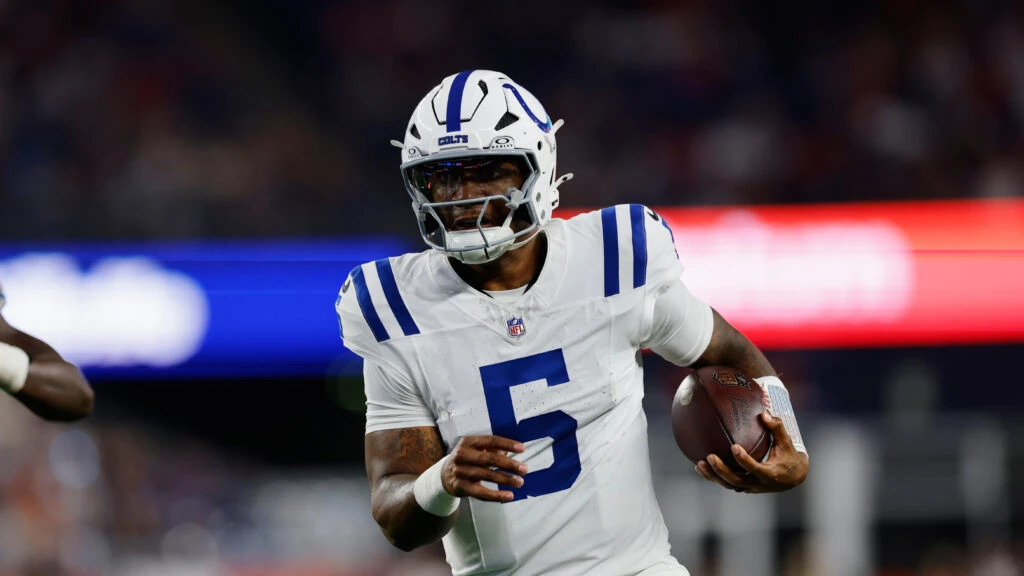
Anthony Richardson, the Indianapolis Colts’ fourth overall draft pick from 2023, made a striking reappearance at the team’s voluntary offseason workouts on Monday—a move few saw coming given the circumstances.
Just days earlier, he’d been training in his Jacksonville, Florida hometown while his agent actively pursued trade opportunities with other NFL franchises. His sudden shift in location and apparent willingness to participate in team activities signals something unexpected: a potential recalibration of his strategy moving forward.
The symbolism of Richardson’s return cannot be overlooked. This is a quarterback who was benched mid-season just months ago, a decision that effectively punctuated his struggles with accuracy and consistency.
Yet here he stands, stepping back into the Colts facility where he faced public scrutiny and organizational doubt. The fact that he chose to show up—after exploring his options elsewhere—suggests internal calculations may have shifted.
Richardson’s first two NFL seasons have been defined by disappointment and unfulfilled potential. The numbers tell a sobering story: through 2025, he’s logged a 50.0% completion percentage and a passer rating of just 62.5, metrics that underscore the substantial gap between his draft pedigree and on-field performance.
High draft picks carry immense pressure, but first-round quarterbacks encounter scrutiny that borders on merciless. For a player selected so early with such optimism surrounding his physical tools, the gap between expectation and reality has been jarring.
Richardson’s early departure from college has emerged as a significant factor in league conversations about his development trajectory. Increasingly, NFL teams recognize that quarterbacks leaving school prematurely face substantial adjustment challenges, and Richardson’s struggles align with broader concerns about young QBs lacking adequate college seasoning.
The competitive environment of professional football demands a level of processing speed and decision-making refinement that additional college years could have provided. This context doesn’t excuse his performance, but it frames his return to workouts within a larger narrative about developmental pathways and the risks inherent in early NFL entry.
Richardson’s 2023 season trajectory underscores these developmental challenges. After being selected fourth overall, his freshman campaign took an unexpected turn when he suffered a severe injury—a Grade 3 AC joint sprain on October 18, 2023—forcing him to miss the remainder of the season.
Following the injury, he underwent shoulder surgery on October 24, 2023 to repair the damage. During his absence, backup quarterback Gardner Minshew assumed the starting role, as the Indianapolis Colts noted, leading the Colts through their remaining contests. The organization finished 9–8 that season, narrowly missing the playoffs after a season-finale loss to the Houston Texans, per the Colts.
From Trade Request to Second Chance: What Richardson Is Really After
The shift from requesting a trade to voluntarily attending team workouts represents more than a simple change of heart. Richardson appears to be executing a calculated repositioning, one that acknowledges the current landscape while hedging his bets for the future.
The Colts organization hasn’t committed to keeping him as their long-term starter—that role belongs to Daniel Jones—but neither have they moved aggressively to trade him away. This ambiguity creates an unusual dynamic where Richardson has leverage in an unexpected way.
Several strategic considerations likely inform Richardson’s return. Free agency in 2027 looms as a potential destination point, a window where he could hit the market with leverage if he’s demonstrated meaningful improvement and reliability.
By showing up at workouts and taking reps, he’s creating leverage even if Indianapolis decides to move on. Teams evaluating quarterback depth would prefer to see him active and competing rather than sitting out and sulking.
The broader quarterback trade market presents an interesting dynamic for Richardson’s positioning. Multiple franchises are actively seeking quarterback depth and trade options, creating a marketplace where his value fluctuates based on demonstrated performance and organizational perception.
The contrast with the Colts’ starting signal-caller is instructive: Jones commands significantly different expectations after compiling a 68.0% completion percentage and a 100.2 passer rating through the 2025 season. If Richardson performs well at workouts and minicamp, his trade candidacy becomes more viable for teams seeking reliable backup options or insurance against injury.
What’s particularly intriguing is how Richardson’s return reframes his narrative within the organization. He’s no longer the player demanding out; he’s the player willing to compete and prove his worth. Whether this shift is genuine or purely tactical matters less than how it’s perceived. The Colts get to evaluate him under pressure and scrutiny, while Richardson gets to work toward potential trade value or future free agency positioning.
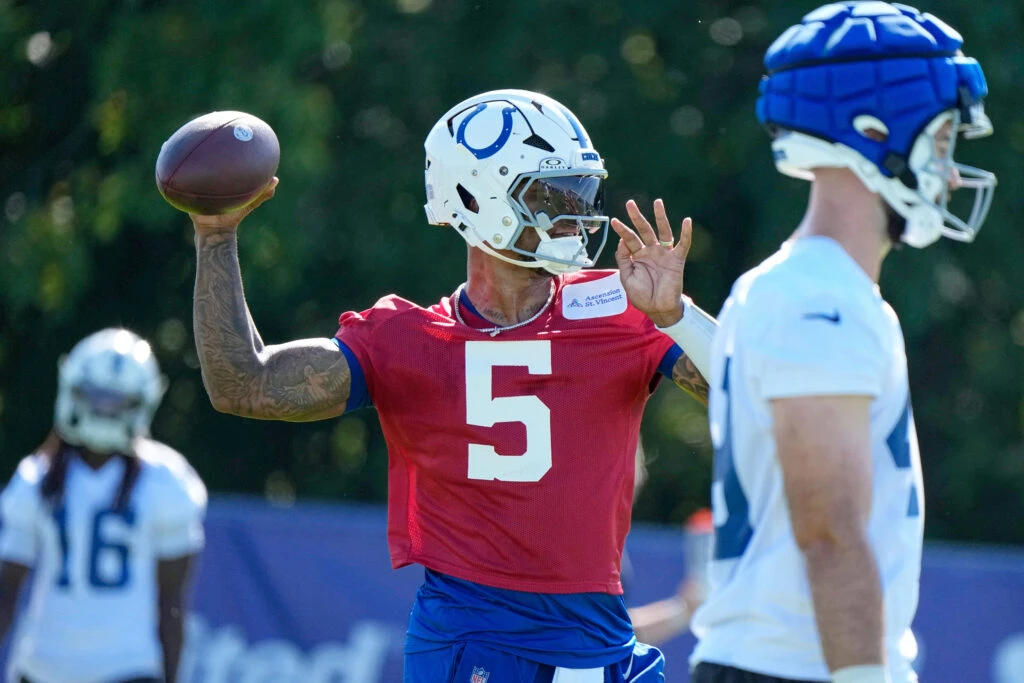
The Eye Injury That Wasn’t: Why Richardson’s Late-Season Performance Matters
One of the most revealing details emerging from Richardson’s late-season practice appearances concerns an eye injury that many observers believed was significantly limiting his performance. According to recent reporting, Richardson impressed during these practice opportunities, effectively dispelling the narrative that his eye injury was the primary culprit behind his struggles. This distinction matters enormously because it reorients the entire conversation about his limitations and potential.
When a quarterback underperforms after suffering an injury, particularly one affecting vision, there’s a natural inclination to attribute struggles to that specific ailment. The eye injury became a convenient explanation for Richardson’s inconsistency and accuracy issues. However, if practice performance demonstrates he can function effectively without that injury being the determining factor, it suggests his earlier struggles stemmed from different sources—developmental shortcomings, mental processing challenges, pressure management, or simple lack of experience.
This revelation is simultaneously encouraging and sobering. Encouraging because it suggests Richardson isn’t permanently limited by physical constraint; sobering because it means his inconsistency was fundamentally a football problem rather than a medical one. Consider his 2025 performance metrics: 41.8 adjusted QBR and an average of just 9.0 yards per pass attempt paint a picture of processing and decision-making deficiencies rather than visual impairment. The good news: football problems can be fixed with proper support, coaching, and opportunity.
Richardson’s late-season practice success provides genuine evidence that fundamental capability exists beneath the surface, waiting to be unlocked with the right circumstances and development framework. The developmental deficits he may have incurred by leaving college early could prove more recoverable with focused work than initially assumed. While his premature entry into professional football may have accelerated his timeline unrealistically, his practice performances suggest the underlying tools and learning capacity are present.
Daniel Jones’s Shadow: How Richardson Could Become Invaluable
The Colts’ decision to sign Daniel Jones to a contract extension introduces a critical variable into Richardson’s situation. While Jones represents the team’s chosen starter, his injury history presents an uncomfortable reality that every team in professional football understands: quarterback depth is never guaranteed. Through 2025, Jones endured 30 total sacks while maintaining a robust 446 passing attempts and 300 completions—statistics that reflect both his durability and the offensive line’s periodic vulnerability. His fragility remains an organizational concern, despite the reasonable performance he demonstrated early in the 2024 season.
Richardson’s sudden presence at workouts transforms from a sideshow into something more strategically significant. From a risk management perspective, Richardson functions as valuable insurance. An organization that committed significant resources to Jones must also acknowledge the possibility that Jones could suffer another injury, requiring a replacement. In that scenario, having a quarterback in your building who already understands your system, knows your playbook, and has taken reps with your offense becomes invaluable.
This dynamic shifts the psychology of the situation in subtle but meaningful ways. Richardson is no longer fighting for a starting job that isn’t available; he’s competing to be essential as backup and emergency option. That’s a lower bar than proving he deserves to start, yet it still provides meaningful pressure and motivation. If Jones remains healthy, Richardson serves his purpose quietly in the background. If Jones gets injured, Richardson suddenly becomes critical to the season’s trajectory.
The Colts have constructed a quarterback roster that hedges against their own uncertainty, and Richardson’s willingness to participate makes him part of that strategy whether by design or opportunity. This positioning also protects Richardson from complete organizational abandonment while maintaining realistic expectations about his immediate role within the franchise’s quarterback hierarchy.
The Twist: Can the Colts’ Biggest Disappointment Become Their Secret Weapon?
As Richardson prepares for upcoming workouts and minicamp, the Indianapolis Colts face an uncommonly ambiguous situation regarding his future. The organization hasn’t definitively committed to keeping him long-term, nor have they aggressively pursued trade options. Instead, they’re effectively granting him the opportunity to earn his way into relevance through performance and professional conduct. Richardson will get reps, will be evaluated under game-like conditions, and will have meaningful opportunities to demonstrate whether his late-season practice success translates into something sustainable.
This scenario contains an element of redemptive possibility that few predicted when the 2024 season concluded. A first-round quarterback benched mid-season, requesting trades, and clearly fallen out of favor could have been destined for journeyman status or worse. Instead, he’s being afforded a pathway—admittedly uncertain and conditional—to reestablish himself within his original organization.
The narrative trajectory here contains genuine intrigue. Richardson could emerge from offseason activities as a credible backup, proving value through consistency and professionalism. By consistently demonstrating the kind of preparation and engagement visible in offseason workouts, he could establish himself as trade bait with renewed credibility, making him attractive to other franchises seeking quarterback depth. Or, through some combination of Jones’s injury and Richardson’s performance, he could unexpectedly thrust himself into competition for playing time.
The Colts haven’t closed the door on Richardson’s future in Indianapolis—they’ve merely left it open, conditional upon his actions and performances in the weeks and months ahead. What he does with that opening could redefine his entire NFL trajectory, transforming him from a cautionary tale about early quarterback exits into a more encouraging narrative about professional resilience and development within established systems.