
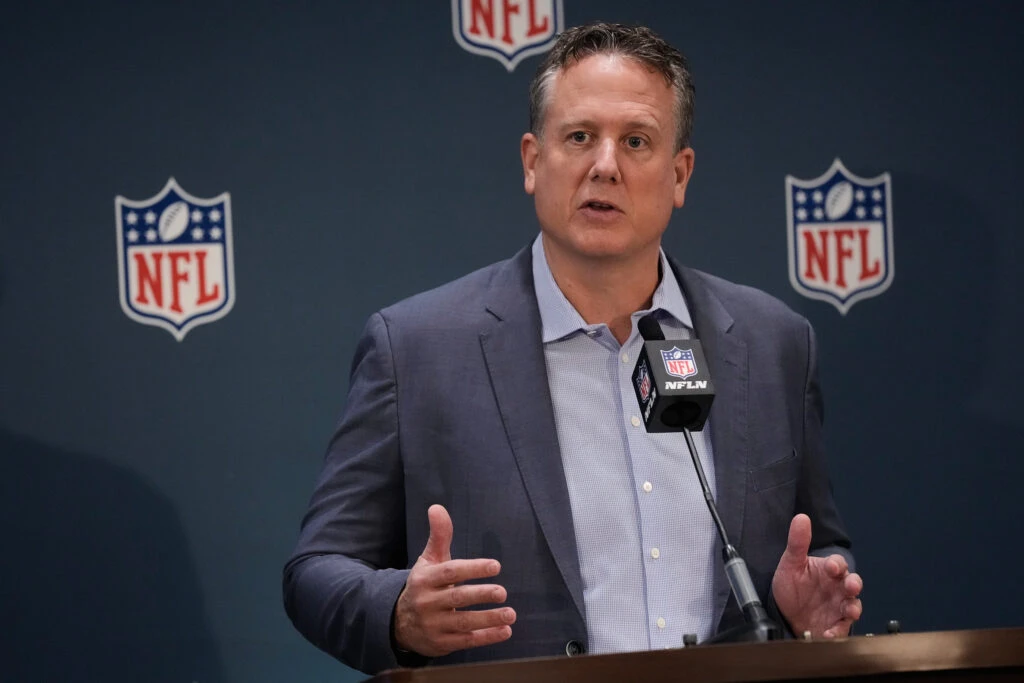
The National Football League recently made a striking admission: their ambitious experiment with dual Monday Night Football games broadcast simultaneously across ABC and ESPN was fundamentally flawed.
Hans Schroeder, NFL Media’s Executive Vice President and Chief Operating Officer, candidly acknowledged that the league and Disney had miscalculated fan behavior and preferences.
Instead of celebrating unprecedented access to premium matchups, audiences experienced decision paralysis. Fans felt genuinely conflicted about choosing between two simultaneous broadcasts featuring their favorite teams. The strategic vision didn’t account for how real people actually consume sports entertainment.
Concrete data underscores this miscalculation—when ESPN and ABC became unavailable on YouTube TV in Week 9 of 2024, Monday Night Football viewership plummeted 21.4 percent year-over-year, demonstrating how fragmentation and viewing complications dramatically diminish engagement.
The repercussions extend far beyond scheduling—they signal a fundamental reckoning within one of America’s most powerful entertainment institutions.
The Paradox of Too Many Choices: When More Options Mean Fewer Viewers
Behavioral economists have extensively documented the paradox of choice—the counterintuitive reality that abundance can paralyze rather than liberate decision-makers.
The NFL’s dual-MNF experiment became an unintentional case study in this psychological principle. Rather than embracing two premium games, audiences experienced anxiety and conflict. This wasn’t about content quality or team matchups; it was about the emotional weight of deciding between competing interests.
The league’s foundational assumption—that choice naturally equals satisfaction—proved dangerously oversimplified. Sports fans seeking relaxation don’t want cognitive burden. They crave clarity and conviction about what to watch.
The league’s 2023 flex scheduling strategy attempted mitigation by enabling ESPN to select more viable matchups in later weeks. Substantial viewership losses when platform distribution becomes complicated illustrate this principle in practice—fragmentation creates barriers that diminish overall engagement.
The contradiction between abundance and satisfaction reveals something profound about media consumption habits extending far beyond football itself.
How Disney’s $55 Billion NFL Deal Forced a Strategic Reckoning
The NFL’s transformative agreement granting Disney control of NFL Network represents one of the most consequential media partnerships in recent entertainment history. This extraordinary arrangement didn’t merely shuffle broadcast rights—it catalyzed fundamental strategic recalibration throughout the league’s entire distribution ecosystem.
By terminating the dual-MNF model, the NFL demonstrated willingness to abandon previous commitments when evidence suggested failure. The evolution reflects this shifting approach. Starting in 2006, when the series moved to cable, programming two games on opening Monday night capitalized on fan interest during “NFL Kickoff weekend.”
Before 2023, the MNF schedule was typically set in Spring with minimal flexibility. The NFL’s decision to expand flex scheduling to MNF beginning in 2023 marked a watershed moment, allowing strategic adjustments rather than rigid planning.
The five remaining unassigned games for the 2026 season will be strategically positioned to maximize engagement rather than proliferation. This represents a decisive philosophical shift from fragmentation toward consolidation—the league’s willingness to leverage market dominance to prioritize ratings and competitive advantage.
What Comes Next: The NFL’s New Playbook for Monday Nights
With the dual-Monday Night experiment officially concluded, the NFL confronts crucial strategic decisions about football’s future on that pivotal evening. Five remaining unassigned games for the 2026 season represent a genuine opportunity to implement lessons learned from recent miscalculation.
These slots could test differentiated approaches—varied platforms, premium matchups, strategic time positioning—while avoiding the paralysis-inducing simultaneity that undermined previous efforts.
The 2023 season provided instructive precedent: ESPN aired four exclusive MNF games on ABC, and on September 18, 2023, ABC simulcast ten additional MNF games originally slated for ESPN alone. The final schedule announcement, expected by May, will reveal whether the NFL has genuinely internalized its audience insights or merely adjusted surface-level tactics.
Success transcends traditional metrics like viewership alone. It concerns whether leadership understands that sophisticated technology and unlimited access mean nothing if audiences experience confusion rather than liberation.
As the NFL continues optimizing its broadcast strategy across the entire week, the fundamental principle remains constant: accessibility and clarity drive engagement far more effectively than platform proliferation.

The Viewer’s Verdict: Why Simultaneous Games Missed the Mark
The response to the dual-MNF experiment from everyday football audiences reveals what the data couldn’t fully capture: the scheduling itself was fundamentally misaligned with how fans actually want to consume the sport.
The simultaneous broadcast window created a practical problem that transcended mere choice theory. When games air at exactly the same time, viewers aren’t experiencing liberation—they’re experiencing frustration.
A simple scheduling adjustment—staggering start times across time zones rather than locking both games into prime time simultaneously—could have produced dramatically different outcomes. An East Coast game beginning at 6 p.m. and a West Coast matchup starting at 9 or 10 p.m. would have given viewers sequential opportunities rather than impossible choices. This represents perhaps the most direct lesson the NFL failed to implement initially: timing matters as much as content quality. Strategic sequencing could have captured “all eyeballs” on both games rather than forcing audiences into a binary choice they resented.
Beyond the scheduling mechanics lies another critical insight: viewer capacity itself has limits. The appetite for consecutive sports entertainment—particularly after an already-saturated weekend—reaches saturation quickly.
Monday Night Football historically succeeds because it offers singular focus and relief from viewing fatigue. Asking audiences to commit to seven hours of football across two consecutive evenings after already consuming an entire Sunday’s worth of games represents a fundamental miscalculation of audience endurance.
The league assumed dedication and availability; audiences demonstrated that sustainable engagement requires restraint and respect for viewer energy levels.