
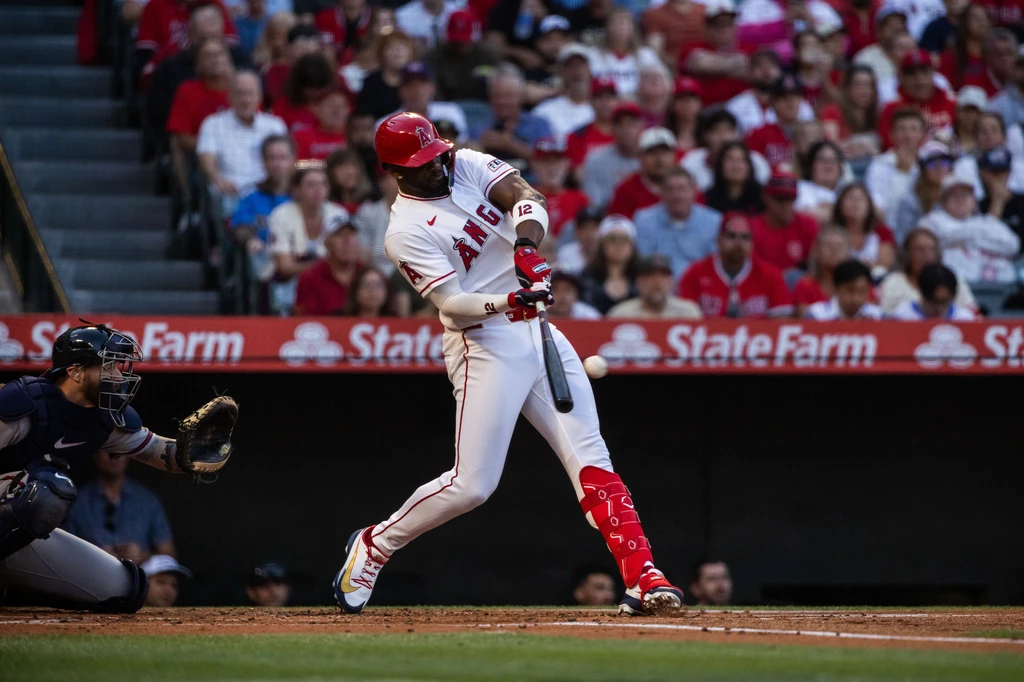
Jorge Soler’s electrifying home run off Reynaldo López in the opening inning sent an unmistakable message across the diamond. The 34-year-old Cuban professional outfielder brought championship pedigree to every at-bat—a World Series MVP with the Braves (2021) and a champion with the Cubs (2016)—launching the ball into the seats and putting the Angels ahead.
But Soler was laboring: his .220 batting average in 2026 suggested he was fighting to find his rhythm, making this early power stroke all the more significant.
López, a 32-year-old Dominican right-hander signed to a three-year, $30 million deal through 2027, arrived with credentials—3.89 career ERA across 271 games and an All-Star selection.
Just three innings later, López delivered his own message: a 96 mph fastball high and inside that struck Soler.
Calculated retaliation or aggressive pitching designed to back off a hot hitter? The answer lay in the tension simmering beneath the surface. The Angels were navigating a grueling travel schedule with late start times, a logistical reality that has increasingly frustrated players and amplified emotional intensity.
As the innings progressed, on-field dynamics and off-field frustrations combined to create conditions where restraint seemed increasingly unlikely.
The Point of No Return: When a Wild Pitch Becomes a Flash Point
The fifth inning proved pivotal. López, working through a difficult start—1-4 with a 1.15 ERA across 15.2 innings—uncorked a high-and-inside wild pitch that ticked off catcher Jonah Heim’s mitt and nearly caught Soler’s head.
For Soler, this was the final straw: the inside fastball during his second at-bat, followed now by a pitch that came perilously close to his face. In that instant, restraint evaporated.
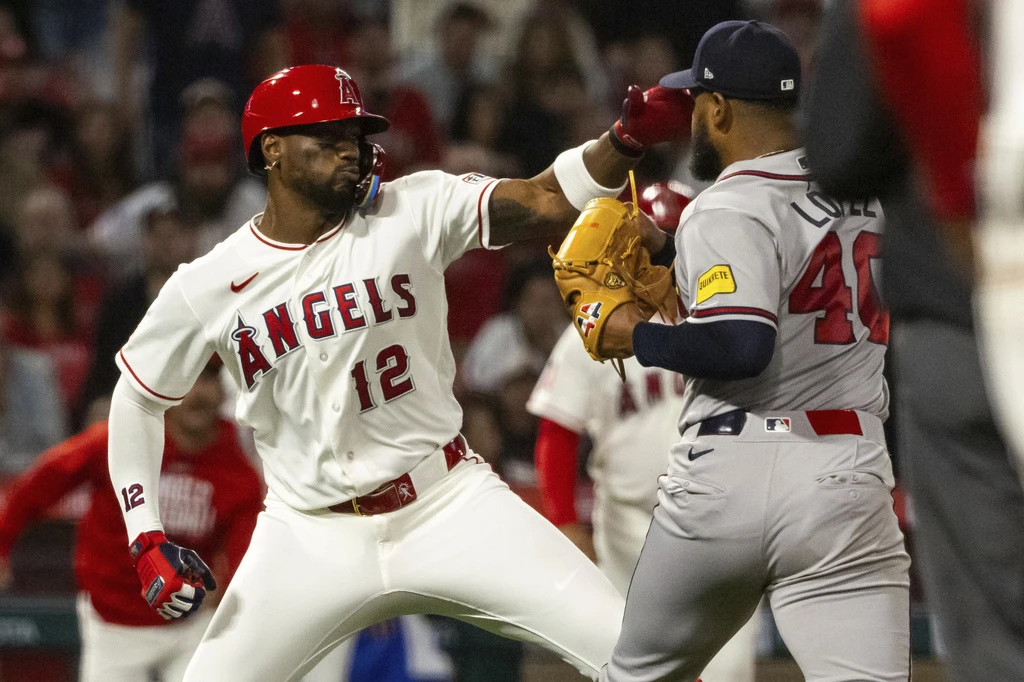
Soler charged the mound with determined intensity, his path set directly toward López. The pitcher, sensing confrontation, raised his hands defensively. For a breathless moment, the entire stadium seemed to pause.
Then came the exchange of punches—a moment that would trigger chaos and reshape the game’s narrative. This turning point echoed a pattern increasingly witnessed across professional sports, where in-game altercations escalate from tension to physical confrontation with startling speed.
Benches Cleared: The Moment Everything Escalated
The exchange between Soler and López transformed instantly from a two-man conflict into stadium-wide bedlam. As they threw punches, López—still gripping the baseball in his right hand—landed a strike toward Soler.
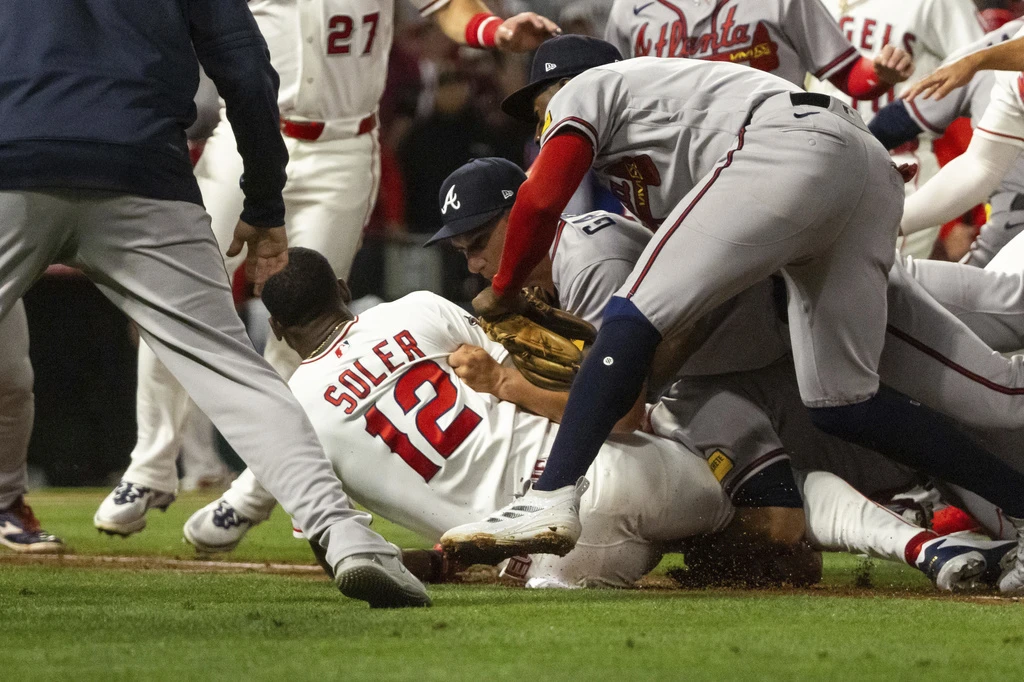
Raw, chaotic, and escalating rapidly. Within seconds, players erupted from both dugouts and bullpens, creating a swirling mass of uniforms converging on the mound.
In dramatic intervention, Braves manager Walt Weiss, Soler’s former bench coach, physically tackled him to the ground alongside catching coach Dustin Garneau in a desperate attempt to suppress the escalating violence.
Order eventually prevailed, but the entire baseball world had witnessed one of the season’s most memorable confrontations.
Both players were ejected immediately, a reminder that despite modern baseball’s emphasis on professionalism, the primal nature of competition can still ignite raw passion. The Braves ultimately prevailed 7-2 despite the chaos.
The Suspension Showdown: MLB’s Verdict and the Last-Minute Twist
Major League Baseball responded swiftly on April 8, 2026—the day after the incident.
Both players faced initial seven-game suspensions coupled with undisclosed financial penalties.
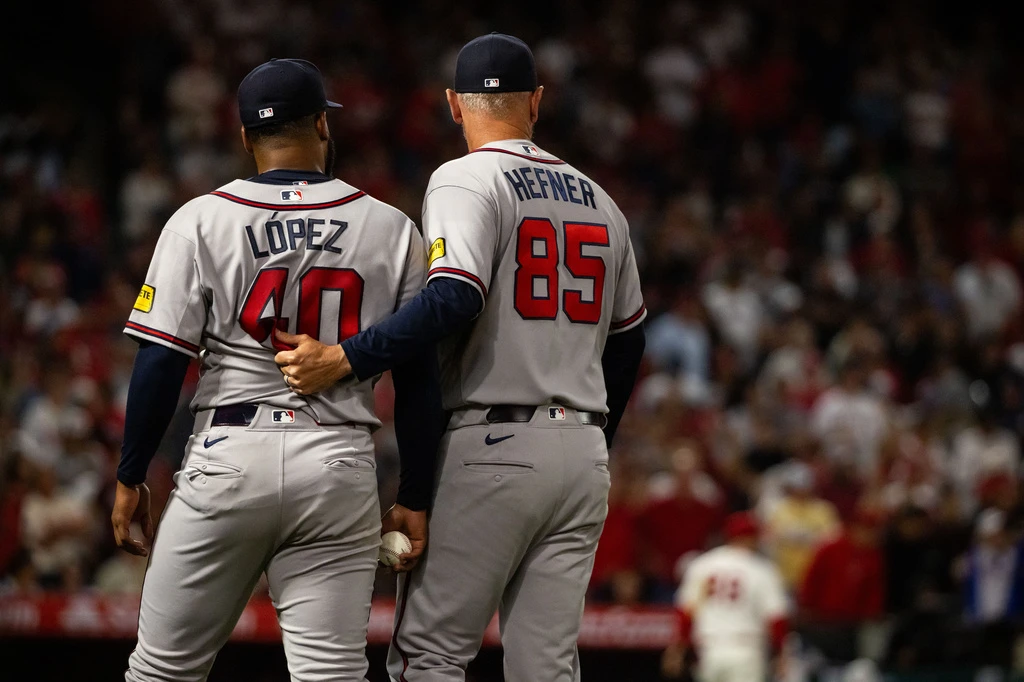
But the story didn’t end there. Behind closed doors, negotiations between MLB officials and the Players Association began, driven by López’s scheduled start for Atlanta and his pivotal role in the Braves’ rotation.
A compromise emerged: López’s suspension was reduced to five games, allowing him to maintain his rotation slot while preserving Atlanta’s competitive position in the NL East.
Soler’s punishment remained unchanged at seven games, reflecting his role as the initial aggressor.
This negotiated outcome revealed the complexity of disciplinary decisions in professional baseball, where game schedules, season implications, and player appeals intersect with league authority.
The differential treatment sparked debate about consistency and fairness, raising questions about whether player position, team impact, and negotiating leverage should influence punishment severity.

The Court of Public Opinion: Questions of Fairness and Precedent
The suspension outcome raised immediate scrutiny around baseball’s disciplinary framework. At its core lay a fundamental tension: Soler received seven games for initiating the physical confrontation, while López’s punishment was negotiated down to five games—a differential that reflected his value to Atlanta’s rotation rather than the severity of his actions.
For many observers, this outcome exemplified a troubling pattern where player utility and team circumstances influence the application of league rules.
The question resonated throughout baseball circles: Should a pitcher’s importance to a playoff-contending team factor into suspension length at all?
The incident became less about the fight itself and more about what the negotiated outcome revealed about how professional baseball actually operates behind closed doors.
This debate extended beyond simple fairness. Soler, as the player who charged the mound, bore responsibility for escalating the physical encounter.
Yet López, who had already thrown two pitches in Soler’s direction (one striking him directly) before the wild pitch, bore responsibility for creating the conditions that led to the confrontation.
The suspension structure seemed to acknowledge Soler’s aggression while simultaneously rewarding López’s team for their relevance to the competitive landscape.
In a sport that prides itself on consistency and rule-based order, such outcomes inevitably spark questions about whether those rules apply equally or whether influence and leverage ultimately determine consequences.
The incident also underscored a broader reality about on-field violence in baseball.
When a pitcher throws a fastball that strikes a batter, or delivers a wild pitch dangerously close to a player’s head, the consequences rarely match the severity of what occurred.
López hit Soler with a baseball—a weapon, by any reasonable definition—yet faced less punishment than the player who retaliated physically.
This asymmetry highlights how baseball culture has long tolerated intimidation and aggression by pitchers as an acceptable part of the game, while treating player-initiated confrontations as the real breach of conduct.
The sport’s implicit code permits violence from the mound in ways it doesn’t permit responses to it.
Whether such a double standard remains appropriate in modern professional athletics became the real question suspended over the entire suspension debate.