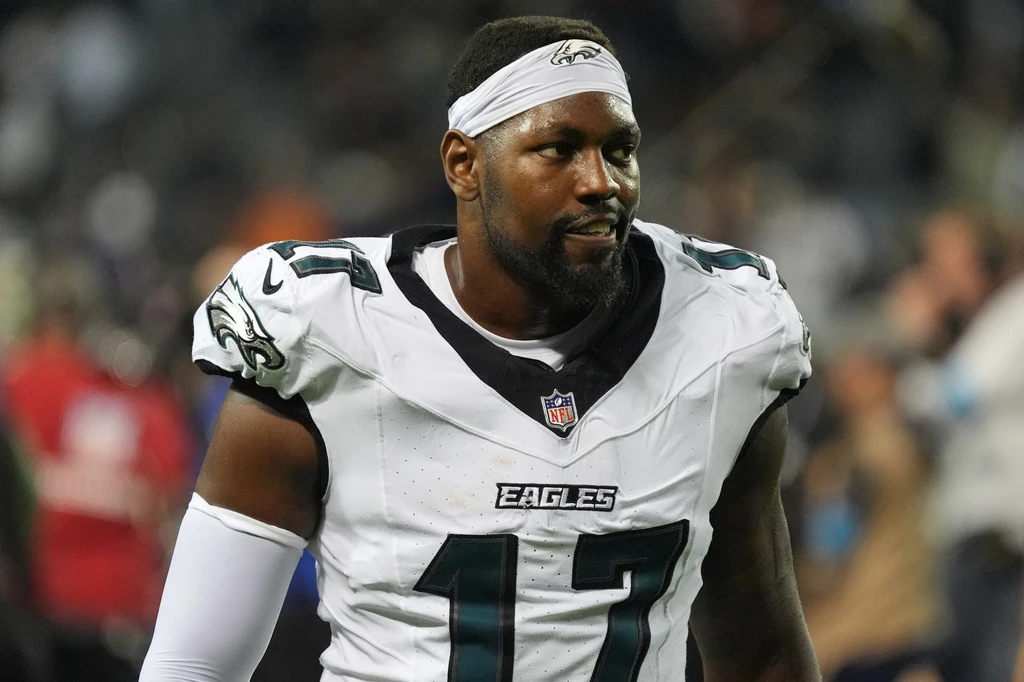
The Cincinnati Bengals’ proposed trade for Philadelphia Eagles edge rusher Arnold Ebiketie collapsed on deadline day after Cincinnati discovered that the transaction could eliminate a projected third-round compensatory selection in the 2027 NFL Draft.
Multiple outlets had reported that the Bengals would send Philadelphia a 2027 sixth-round pick for Ebiketie. The agreement was never finalized, however, and Cincinnati withdrew before the NFL’s Nov. 10 trade deadline.
The reversal left the 6-2 Bengals without a deadline acquisition as they prepared to face the Pittsburgh Steelers with first place in the AFC North at stake. More importantly, it illustrated how an inexpensive-looking trade can carry a much larger cost under the NFL’s compensatory-pick rules.
Why Cincinnati Walked Away
Bengals coach Zac Taylor confirmed that Cincinnati, rather than Philadelphia, stopped the transaction.
Taylor said the proposed move became “a little more costly than we initially anticipated.” He also described Philadelphia as “a great trade partner” and added, “It was on our end,” according to NFL.com’s account of his remarks.
Cincinnati had explored the trade while seeking depth behind injured edge defender Cashius Howell. Ebiketie offered experience at the position, having accumulated 16.5 sacks over his first four NFL seasons with the Atlanta Falcons before signing a one-year contract with Philadelphia in March.
The Eagles’ official announcement identified Ebiketie as a 27-year-old outside linebacker who had produced at least 29 quarterback pressures in each of his first four seasons.
His 2026 production had been more limited. Through nine games with Philadelphia, Ebiketie had 25 combined tackles and no sacks, according to his NFL statistics. The proposed sixth-round price therefore appeared to reflect a depth addition rather than a move for a proven, high-impact starter.
How the Compensatory Formula Changed the Price
The problem was not a rule prohibiting the trade. It was the effect Ebiketie’s contract would have had on Cincinnati’s compensatory-free-agent calculation.
Under Appendix V of the NFL collective bargaining agreement, teams may receive compensatory draft selections when they lose more qualifying compensatory free agents than they sign or acquire. The formula also considers contract value, playing time and postseason honors when determining the potential round of a selection.
A specific provision applies to trades: If a club acquires a player who qualified as a compensatory free agent during that league year, he is treated as a compensatory free agent gained by his new team.
Ebiketie had qualified when he signed with Philadelphia. Acquiring him would therefore have added another qualifying arrival to Cincinnati’s calculation, even though the Bengals would have obtained him through a trade rather than signing him directly in free agency.
The Bengals had lost three qualifying free agents and added two, according to the calculation reported by NFL Network and contract analyst Nick Korte. Cincinnati was consequently projected to receive a third-round compensatory selection connected to Trey Hendrickson’s departure for the Baltimore Ravens.
Adding Ebiketie would have changed that balance and was expected to cancel the Hendrickson-related selection. That meant Cincinnati was not merely considering whether Ebiketie was worth a 2027 sixth-round pick. The practical decision was whether a part-time edge defender was worth both the sixth-round selection and the likely loss of a much more valuable projected third-rounder.
The Bengals decided he was not.
The third-round selection should still be described as projected, rather than guaranteed. Compensatory picks are calculated after the season and formally awarded by the NFL. Playing time and other formula components can affect the final results.
Why the Hendrickson Projection Matters
Hendrickson’s departure carries particular weight because of what he produced during his Cincinnati career. He led the NFL with 17.5 sacks in 2024, becoming the first Bengals player to win the league sack title since sacks became an official statistic in 1982.
That season ended with Cincinnati at 9-8 and outside the playoffs despite major individual performances from Hendrickson, quarterback Joe Burrow and receiver Ja’Marr Chase. The contrast reinforced the importance of maintaining both defensive talent and future draft resources.
A projected third-round selection would give Cincinnati an opportunity to add a cost-controlled player or use the pick in a future trade. Sacrificing that asset for a short-term reserve with no sacks through nine games would have been difficult to justify, even for a team trying to strengthen its pass rush during a playoff race.
The Bengals’ Position After the Deadline
Cincinnati emerged from the deadline with the same roster but a four-game winning streak and a share of the AFC North lead. The Bengals improved to 6-2 with a 34-17 victory over Atlanta in Madrid, matching Pittsburgh’s record.
Burrow had completed 219 of 296 passes for 2,386 yards, 23 touchdowns and six interceptions through eight games, according to NFL statistics. Cincinnati’s offense had also scored at least 30 points in four consecutive games, tying a franchise record, according to the Bengals’ Week 9 recap.
The failed trade nevertheless leaves a clear football concern. Cincinnati investigated Ebiketie because it wanted additional edge depth, and walking away did not eliminate that need. With the deadline closed, the Bengals must rely on their existing defensive rotation and any eligible free agents they can sign.
The episode also invites reasonable questions about when Cincinnati identified the compensatory-pick consequence. Taylor acknowledged that the complication emerged as the organization worked through the transaction, but he did not provide a detailed account of the internal process. Without further information from personnel director Duke Tobin or another team official, claims that an outside social-media post single-handedly stopped the trade remain unconfirmed.
What can be established is simpler: Cincinnati agreed in principle to a modest trade, determined that the transaction carried a potentially substantial additional cost and withdrew before the deal became official. Protecting the projected third-round selection was the defensible decision, even if reaching that conclusion so late created an avoidable deadline-day controversy.