Russell Westbrook’s journey from an 18-year-old prospect drafted 4th overall by Oklahoma City in 2008 — as Basketball-Reference’s draft record confirms — to NBA history-maker is nothing short of remarkable.
The Sacramento Kings veteran has spent nearly two decades etching his name into the record books, navigating a career path that has taken him through Houston, Washington, Los Angeles (twice), Denver, and finally California’s capital.
The historic moment arrived on January 3, 2026, during a 129–102 loss to the Phoenix Suns: a layup with 4:23 left in the fourth quarter that surpassed Oscar Robertson’s scoring record.
Westbrook posted 17 points, nine rebounds, and six assists in just 26 minutes, claiming the title of NBA’s highest-scoring point guard while simultaneously moving into 15th place on the league’s all-time scoring list.
His transformation from high-volume scorer to complementary veteran underscores remarkable adaptability.
Where once Westbrook dominated the offensive load, he’s evolved into a bench leader and stabilizing force for contending rosters on veteran minimum contracts.
Kings head coach Doug Christie praised the achievement, highlighting Westbrook’s competitiveness and elite performance in his 18th season—a testament to how longevity demands not just physical endurance but tactical reinvention and unwavering commitment to team success.


Why Breaking Oscar Robertson’s Record Feels Different
Russell Westbrook’s path from an 18-year-old drafted 4th overall by the Oklahoma City Thunder in 2008 to NBA record-breaker is one of the most compelling career arcs in league history.
The defining moment arrived on January 3, 2026, during a 129–102 loss to the Phoenix Suns: a layup with 4:23 remaining in the fourth quarter that pushed Westbrook past Oscar Robertson’s all-time scoring record for point guards.
He finished that night with 17 points, nine rebounds, and six assists in 26 minutes, simultaneously moving into 15th place on the NBA’s all-time scoring list.
The milestone crystallizes a career-long evolution — from the high-usage, triple-double machine who carried Oklahoma City’s offense to a bench leader and stabilizing presence operating on veteran minimum contracts.
Kings head coach Doug Christie called out Westbrook’s competitiveness directly after the game, noting that performing at an elite level in an 18th NBA season demands more than physical durability — it requires tactical reinvention and a willingness to subordinate individual production to team success.
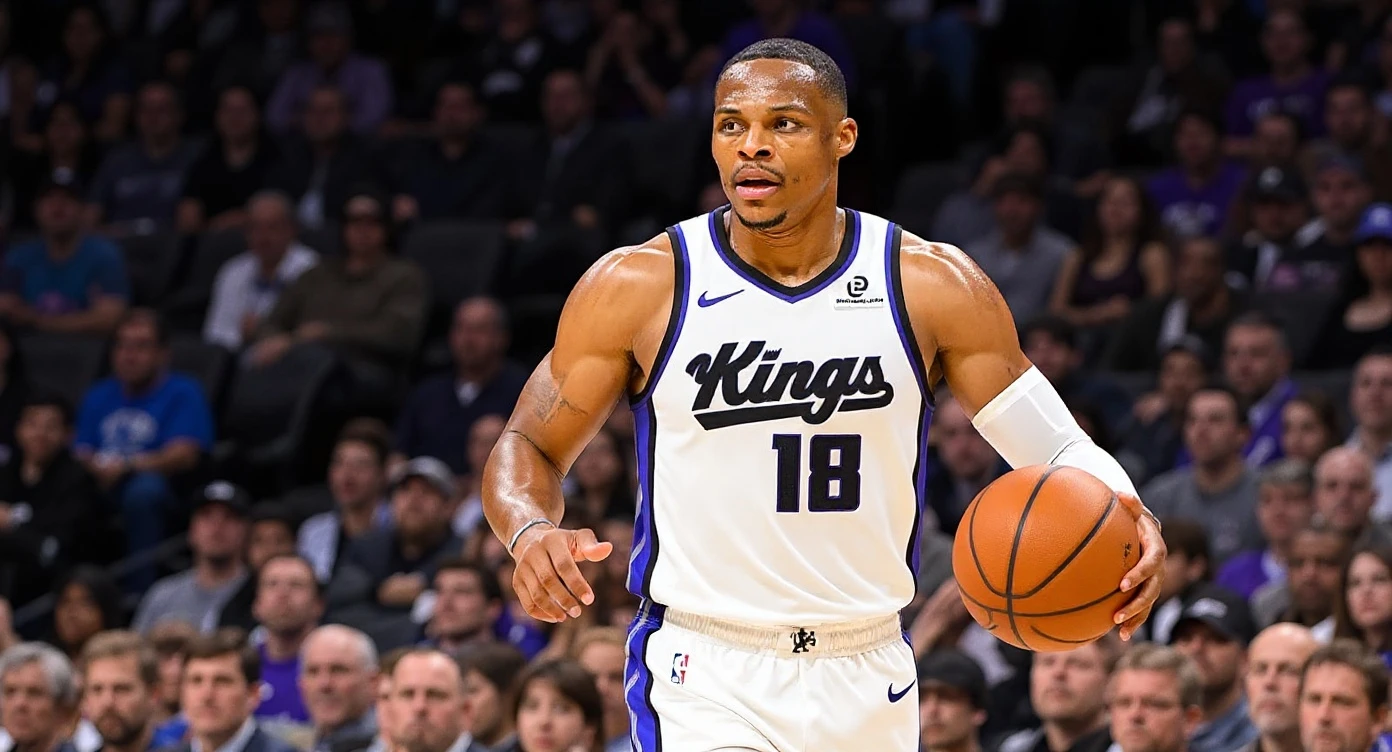
Eight All-Stars, Two Scoring Titles, and One MVP: The Hardware Collection
Oscar Robertson’s scoring mark had stood as one of basketball’s most durable benchmarks for decades. Robertson closed his Hall of Fame career with 26,710 points at a 25.7-point-per-game average — ninth-highest in NBA history — a standard that seemed untouchable for any point guard who followed.
Westbrook’s surpassing of that record at age 37 carries added weight because of how he got there.
This season, Westbrook is averaging 14.4 points, 7.0 assists, and 6.6 rebounds per game while shooting a career-high 35.3% from three-point range — a figure that reflects a deliberate and intelligent reshaping of his offensive game to fit the modern, perimeter-oriented NBA.
Though Sacramento fell to Phoenix that night, the result was secondary. Westbrook’s achievement lands during an era when the league’s elder statesmen are fundamentally challenging assumptions about athletic decline.
LeBron James competed at age 40 and maintained a 1,344-game double-figure scoring streak spanning nearly 19 years before it ended.
The sustained excellence of players like James and Westbrook points to a broader shift driven by advances in sports science, load management, and player conditioning — one that has redefined what a career’s final chapters can look like.
Still Writing History: What Comes Next for Westbrook?
Westbrook’s résumé reads as a sustained argument for his place among the most complete point guards the game has produced.
His 11 seasons with the Oklahoma City Thunder generated eight All-Star selections and two scoring titles — in 2014–15 and 2016–17, both recognized by Basketball-Reference — along with the 2016–17 MVP Award, a season in which he averaged a triple-double for the entire year, the first player to do so since Robertson in 1961–62, as the NBA’s season review notes. His triple-double production alone separates him from every player in NBA history.
On November 19, Westbrook recorded his 200th career triple-double, becoming the first player ever to reach that threshold.
He now owns 204 regular-season triple-doubles, surpassing Robertson’s previous record of 181 — a mark many considered permanent.
These numbers reframe Westbrook not simply as a scorer chasing a points record, but as a multi-dimensional player who consistently impacted winning across franchise rebuilds, playoff contenders, and championship rosters throughout his career.