Aaron Rodgers, one of football’s most enigmatic and talented quarterbacks, is embarking on what could be his final NFL season. The 42-year-old signed a one-year deal with the Pittsburgh Steelers following his release by the New York Jets after the 2024 season. This “Goodbye Tour” has everyone asking: is this the beginning of the end for one of the greatest to ever play the position, or the perfect setup for one last championship run? Standing 6-2 and weighing 223 pounds, Rodgers’ physical presence belies his cerebral mastery of the game. His journey from backing up Brett Favre for three years to becoming the Packers’ starting quarterback in 2008 showcases his patience and eventual dominance. At this stage of his career, every decision carries weight, every throw might matter, and every game could define his legacy. Rodgers’ move to Pittsburgh represents far more than a typical veteran signing—it’s a calculated final chapter in one of sports’ most compelling narratives.




From Perfectionist to Steelers: Why Rodgers’ Career Defies Convention
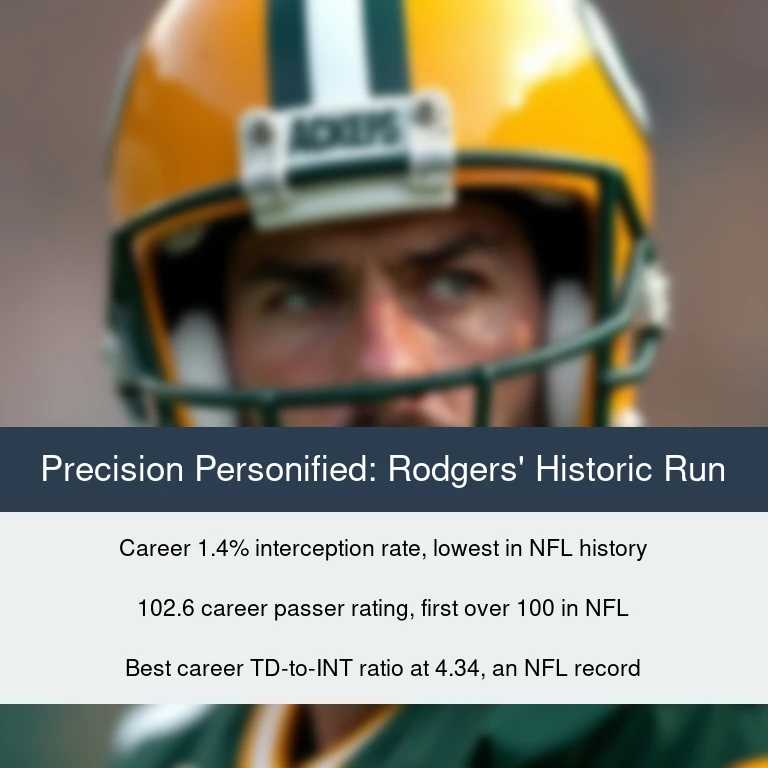
With four AP MVP awards, four additional PFWA MVP honors, ten Pro Bowl selections, and four All-Pro designations, Rodgers has already cemented his place among football’s immortals. He won Super Bowl XLV in the 2010 season, earning Super Bowl MVP honors, and was named AP Athlete of the Year in 2011. His career Approximate Value stands at an elite 169, ranking third overall since 1960. Yet what truly distinguishes him from other elite quarterbacks is his surgical precision. His 1.4% career interception rate stands as the lowest in NFL history—a staggering achievement that reflects not just talent but meticulous decision-making under pressure. His 102.6 career passer rating towers above virtually every peer, and he’s the first player in NFL history to achieve a career passer rating over 100, now ranking first all-time in the regular season. Most impressively, he holds the best touchdown-to-interception ratio in NFL history at 4.34. His winding path from Green Bay to New York to Pittsburgh reveals something profound: sometimes legacy isn’t linear, yet even when navigating uncertain terrain, transcendent talent finds its way forward.

The Mysterious Hand and the Calm Before the Storm
Beyond the statistics lies something more intangible but equally defining—Rodgers’ reputation for delivering when stakes reach their highest. His trademark calm in pressure-packed moments has earned him legendary status as one of football’s greatest closers. There’s an almost supernatural quality to his ability to will his team to victory in moments when ordinary quarterbacks falter. His field vision transcends typical quarterback awareness; he sees angles and opportunities others miss, seemingly frozen in time during chaos. Scouts and analysts have long noted his unique ability to perform in final-moment scenarios, converting impossible situations into victories. His college career at California, following his transfer from Butte Junior College, foreshadowed this excellence. As he enters Pittsburgh, the question becomes whether this mystical quality—this ability to command gravity itself—remains intact after years of organizational turbulence. His 2025 campaign with the Steelers demonstrated his enduring capability: 3,322 passing yards, 24 touchdowns, and just 7 interceptions over 16 games, showcasing the precision that defined his entire career.

Can a 20-Year Veteran Still Be a Game-Changer? The Steelers’ Calculated Gamble
Pittsburgh’s decision to sign Rodgers on a one-year contract represents a bold wager that elite talent transcends age and circumstance. For a franchise accustomed to excellence—the Steelers have won six Super Bowls across eight appearances—this signing carries strategic weight. With 264 career games played, a 163-93-1 regular-season record, 66,274 passing yards, and 527 touchdowns, his pedigree speaks for itself. The 2025 season validates Pittsburgh’s confidence: the Steelers finished first in their division with a 10-7 record, with Rodgers compiling a 10-6 mark. Pairing the Steelers’ formidable defense with elite quarterback play creates a championship formula. However, the one-year contract structure cuts both ways: it demonstrates Pittsburgh’s confidence while acknowledging uncertainty about long-term availability. At this stage of his career, Rodgers must prove he can still elevate teammates and perform under the playoff pressure Pittsburgh demands. The clock is definitively ticking—for Rodgers personally and for Pittsburgh’s championship window. Whether this represents the perfect collision of destiny and timing or a poignant coda to an incomparable career remains to be written.