
In the ever-evolving world of sports, a surprising revelation has taken center stage – Miami’s lucrative journey through the FIFA Club World Cup. What seemed like a mere tournament has unraveled into a financial windfall that has left experts and fans alike in awe.

Uncovering Miami’s Lucrative World Cup Journey
Inter Miami’s run through the 2025 FIFA Club World Cup turned heads for more than just the soccer.
While Lionel Messi and company competed on the pitch against some of the world’s elite clubs, the front office was quietly stacking a financial return that few American soccer clubs have ever seen.
By the time Miami’s tournament run ended, the club had secured $21.5 million in FIFA prize money — a figure that signals a new era for MLS clubs competing on the global stage.

The Staggering Prize Money Revealed
Miami entered the expanded 32-team Club World Cup as one of two MLS representatives, alongside the Seattle Sounders, and immediately faced skepticism about whether an American club could hold its own against European and South American heavyweights.
What followed was a group stage performance that silenced some of those doubters. Miami navigated a competitive group with two draws and a pivotal win, earning enough points to advance to the Round of 16 — a result that few analysts had penciled in before the tournament began.
The $21.5 million prize haul was the direct financial reward for that run, and it represents one of the largest single-tournament payouts in the history of American club soccer.
How Miami’s Winnings Dwarf MLS Glory
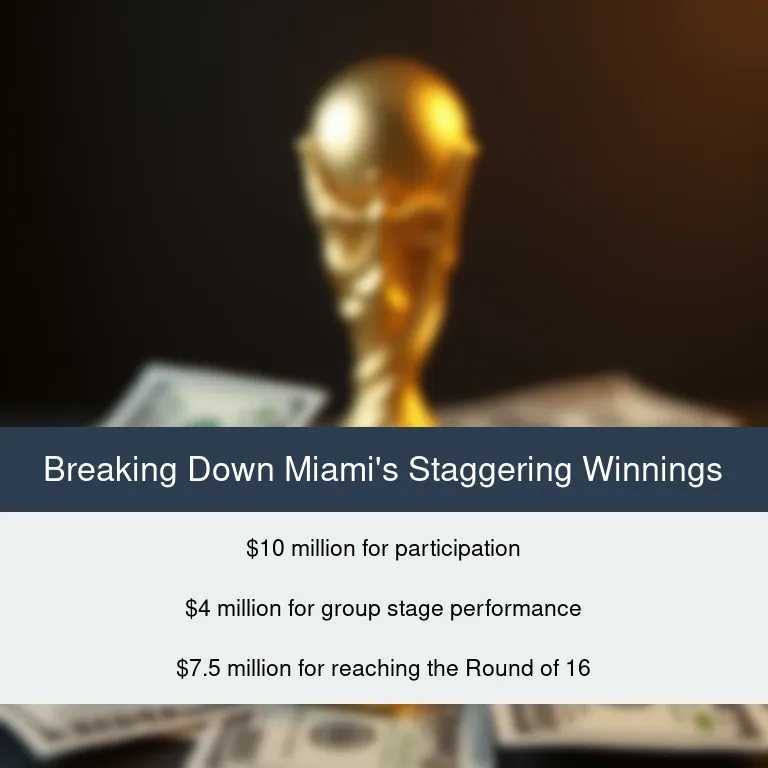
The prize money breakdown tells the full story of how Miami built that $21.5 million figure. FIFA awarded the club $10 million simply for participating in the expanded tournament — a baseline payment that applied to all 32 clubs.
From there, Miami’s on-field results added layers to that total. Their two draws and one group stage victory generated an additional $4 million in performance bonuses, based on the Club World Cup prize breakdown reported by NBC Sports.
The decisive financial leap came with their advancement to the Round of 16, which triggered a $7.5 million payout confirmed in NBC Sports’ prize-money breakdown.
Each round of progression in the Club World Cup carries escalating prize values, meaning clubs that advance deep into the bracket can dramatically outpace those that exit in the group stage. Miami maximized that structure as far as their run allowed.

Exploring the Financial Impact Beyond the Pitch
To frame the scale of that $21.5 million figure in domestic terms: the MLS Cup winner receives a prize pool that, distributed across the roster, amounts to a fraction of what Miami earned in this single tournament.
Reports have placed the MLS Cup winner’s share at roughly $300,000 per player in recent seasons, meaning Miami’s Club World Cup earnings dwarf what a domestic championship delivers in raw financial terms.
The gap between international FIFA prize money and domestic competition payouts reflects a broader structural reality in global soccer — the biggest financial rewards flow through FIFA and UEFA competitions, not domestic leagues, regardless of how prestigious those leagues are. For Miami, that reality just became very tangible.

The downstream impact of this windfall matters as much as the number itself. Miami already operates as one of MLS’s highest-spending clubs, with a roster that includes Messi, Sergio Busquets, and Jordi Alba — three players whose combined wages represent an investment that most MLS clubs cannot approach.
The $21.5 million injection gives the club’s ownership group, which includes Jorge Mas and David Beckham, additional capital to reinvest in squad depth, infrastructure, and academy development.
Inter Miami has been building toward a new stadium in Miami’s Overtown neighborhood, a project that requires sustained financial momentum. Prize money at this scale accelerates that timeline and strengthens the club’s negotiating position when pursuing future transfer targets.
Beyond Miami’s balance sheet, the Club World Cup result carries implications for MLS as a whole. American clubs have historically been viewed as soft draws in international competition, but Miami’s Round of 16 appearance challenges that narrative.
If MLS clubs can demonstrate they belong in the later rounds of FIFA’s marquee club tournament, the league’s global profile rises — and with it, the commercial appeal that drives sponsorship revenue, broadcast deals, and player recruitment.
The 2025 Club World Cup was the first edition of the expanded format, meaning the prize structures, viewership numbers, and competitive outcomes will shape how FIFA calibrates future editions. Miami’s performance gave MLS a meaningful data point in that conversation.
For context on what $21.5 million means in the current MLS financial environment: the league’s total player salary budget for a single club in 2024 sat at roughly $5.2 million under the standard cap, with designated player spending layered on top of that.
Miami’s Club World Cup earnings alone could theoretically fund multiple seasons of base roster spending. That kind of financial leverage, generated in a matter of weeks on the international stage, underscores why clubs like Miami are increasingly treating global tournaments not just as competitive opportunities, but as revenue events that can reshape their long-term financial planning.